 930cf29367
Reviewed By: alexsn

Differential Revision: D16782780

fbshipit-source-id: 084a50bc935597a5be8a5c04b2f9347e683ea45a
8.2 KiB
Executable File
id, title, sidebar_label
| id | title | sidebar_label |
|---|---|---|
| getting-started | Quick Introduction | Quick Introduction |
ent is a simple, yet powerful entity framework for Go built with the following principles:
- Model your data as graph easily.
- Defining your schema as code.
- Static typing first based on code generation.
- Make the work with graph-like data in Go easier.
Installation
$ go get github.com/facebookincubator/ent/entc/cmd/entc
After installing entc (the code generator for ent), you should have it in your PATH.
Create Your First Schema
Go to the root directory of your project, and run:
$ entc init User
The command above will generate the schema for User under <project>/ent/schema/ directory:
// <project>/ent/schema/user.go

package schema

import "github.com/facebookincubator/ent"

// User holds the schema definition for the User entity.
type User struct {
	ent.Schema
}

// Fields of the User.
func (User) Fields() []ent.Field {
	return nil
}

// Edges of the User.
func (User) Edges() []ent.Edge {
	return nil
}
Let's add 2 fields to the User schema, and then run entc generate:
// Fields of the User.
func (User) Fields() []ent.Field {
	return []ent.Field{
		field.Int("age").
			Positive(),
		field.String("name").
			Default("unknown"),
	}
}
Running entc generate from the root directory of the project:
$ entc generate ./ent/schema
Will produce the following files:
ent
├── client.go
├── config.go
├── context.go
├── ent.go
├── example_test.go
├── migrate
│   ├── migrate.go
│   └── schema.go
├── predicate
│   └── predicate.go
├── schema
│   └── user.go
├── tx.go
├── user
│   ├── user.go
│   └── where.go
├── user.go
├── user_create.go
├── user_delete.go
├── user_query.go
└── user_update.go
Create Your First Entity
First thing we need to do, is creating a new ent.Client. For the example purpose,
we will use SQLite3.
package main

import (
	"log"

	"<project>/ent"

	"github.com/facebookincubator/ent/dialect/sql"
	_ "github.com/mattn/go-sqlite3"
)

func main() {
	db, err := sql.Open("sqlite3", "file:ent?mode=memory&cache=shared&_fk=1")
	if err != nil {
		log.Fatalf("failed opening connection to sqlite: %v", err)
	}
	defer db.Close()
	drv := dialect.Driver(db)
	if testing.Verbose() {
		drv = dialect.Debug(drv)
	}
	client := ent.NewClient(ent.Driver(db))
	// run the auto migration tool.
	if err := client.Schema.Create(context.Background()); err != nil {
		log.Fatalf("failed creating schema resources: %v", err)
	}
}
Now, we're ready to create our user. Let's call this function Do for the sake of the example:
func Do(ctx context.Context, client *ent.Client) (*ent.User, error) {
	u, err := client.User.
		Create().
		SetAge(30).
		SetName("a8m").
		Save()
	if err != nil {
		return nil, fmt.Error("failed creating user: %v", err)
	}
	log.Println("user was created: %v", u)
	return u, nil
}
Query Your Entities
entc generates a package for each entity schema that contains its predicates, default values, validators
and information about storage elements (like, column names, primary keys, etc).
package main

import (
	"log"

	"<project>/ent"
	"<project>/ent/user"
)

func Query(ctx context.Context, client *ent.Client) (*ent.User, error) {
	u, err := client.User.
		Query().
		Where(user.NameEQ("a8m")).
		// `Only` fails if no user found,
		// or more than 1 user returned.
		Only(ctx)
	if err != nil {
		return nil, fmt.Error("failed querying user: %v", err)
	}
	log.Println("user: %v", u)
	return u, nil
}
Add Your First Edge (Relation)
In this part of the tutorial, we want to declare an edge to another entity in the schema.
Let's create 2 additional entities named Car and Group with a few fields. We use entc
to generate the initial schema:
$ entc init Car Group
And then, we add the rest of the fields manually:
import (
	"log"

	"github.com/facebookincubator/ent"
	"github.com/facebookincubator/ent/field"
)

// Fields of the Car.
func (Car) Fields() []ent.Field {
	return []ent.Field{
		field.String("model"),
		field.Time("registered_at"),
	}
}


// Fields of the Group.
func (Group) Fields() []ent.Field {
	return []ent.Field{
		field.String("name").
			// regexp validation for group name.
			Match(regexp.MustCompile("[a-zA-Z_]+$")),
	}
}
Let's define our first relation. An edge from User to Car defining that a user
can have 1 or more cars, but a car has only one owner (one-to-many relation).
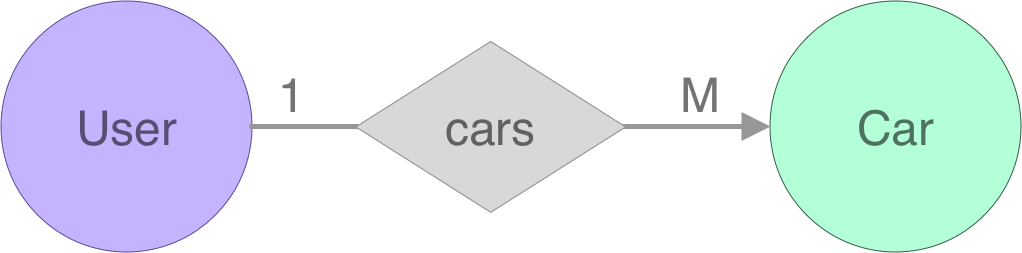
Let's add the "cars" edge to the User schema, and run entc generate ./ent/schema:
import (
	"log"

	"github.com/facebookincubator/ent"
	"github.com/facebookincubator/ent/edge"
)

// Edges of the User.
func (User) Edges() []ent.Edge {
	return []ent.Edge{
   	edge.To("cars", Car.Type),
	}
}
We continue our example, by creating 2 cars, and add them to a user.
func Do(ctx context.Context, client *ent.Client) error {
	// creating new car with model "Tesla".
	tesla, err := client.Car.
		Create().
		SetModel("Tesla").
		SetRegisteredAt(time.Now()).
		Save(ctx)
	if err != nil {
		return fmt.Errorf("failed creating car: %v", err)
	}

	// creating new car with model "Ford".
	ford, err := client.Car.
		Create().
		SetModel("Ford").
		SetRegisteredAt(time.Now()).
		Save(ctx)
	if err != nil {
		return fmt.Errorf("failed creating car: %v", err)
	}
	log.Println("car was created: %v", ford)

	// create a new user, and add it the 2 cars.
	a8m, err := client.User.
		Create().
		SetAge(30).
		SetName("a8m").
		AddCars(tesla, ford).
		Save(ctx)
	if err != nil {
		return fmt.Errorf("failed creating user: %v", err)
	}
	log.Println("user was created: %v", a8m)
}
But, what about querying the "cars" edge? Here's how we do it:
import (
	"log"

	"<project>/ent"
	"<project>/ent/car"
)

func Do(ctx context.Context, client *ent.Client) error {
	// <continuation of the code block above>
	// ...

	cars, err := a8m.QueryCars().All(ctx)
	if err != nil {
		return fmt.Errorf("failed querying user cars: %v", err)
	}
	log.Println(cars...)

	// what about filtering specific cars.
	ford, err := a8m.QueryCars().
		Where(car.NameEQ("Ford")).
		Only(ctx)
	if err != nil {
		return fmt.Errorf("failed querying user cars: %v", err)
	}
	log.Println(ford)
}
Add Your First Inverse Edge (BackRef)
Assume we have a Car object and we want to get its owner; The user that this car belongs to.
For this, we have another type of edge called "inverse edge" that is defined using the edge.From
function.
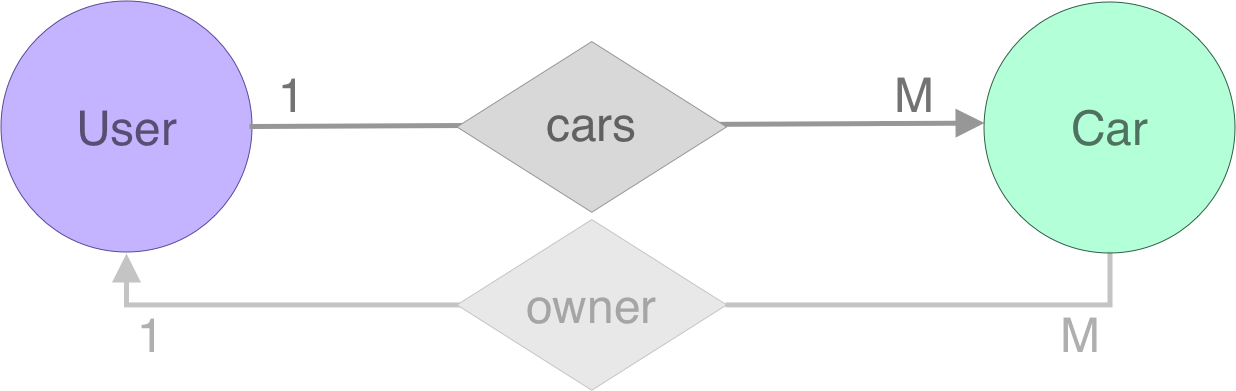
The new edge created in the diagram above is transparent, to emphasis that we don't create another edge in the database, and it is just a back-reference to the real edge.
Let's add an inverse edge named "owner" to the Car schema, reference it to the "cars" edge
in the User schema, and run entc generate ./ent/schema.
import (
 "log"

 "github.com/facebookincubator/ent"
 "github.com/facebookincubator/ent/edge"
)

// Edges of the Car.
func (Car) Edges() []ent.Edge {
 return []ent.Edge{
	 // create an inverse-edge called "owner" of type `User`
	 // and reference it to the "cars" edge (in User schema)
	 // explicitly using the `Ref` method.
	 edge.From("owner", User.Type).
	 	Ref("cars").
		// setting the edge to unique, ensure
		// that a car can have only one owner.
		Unique(),
	}
}
We'll continue the user/cars example above by querying the inverse edge.
import (
	"log"

	"<project>/ent"
)

func Do(ctx context.Context, client *ent.Client) error {
	// <continuation of the code block above>
	// ...

	cars, err := a8m.QueryCars().All(ctx)
	if err != nil {
		return fmt.Errorf("failed querying user cars: %v", err)
	}

	// query the inverse edge.
	for _, car := range cars {
		owner, err := car.QueryOwner().Only(ctx)
		if err != nil {
			return fmt.Errorf("failed querying car %q owner: %v", car.Model, err)
		}
		log.Printf("car %q owner: %q", car.Model, owner.Name)
	}
}
Create Your Second Edge
TODO: User/Group example.