## Summary
- add `self_serve_business_usage_based` and `enterprise_cbp_usage_based`
to the public/internal plan enums and regenerate the app-server + Python
SDK artifacts
- map both plans through JWT login and backend rate-limit payloads, then
bucket them with the existing Team/Business entitlement behavior in
cloud requirements, usage-limit copy, tooltips, and status display
- keep the earlier display-label remap commit on this branch so the new
Team-like and Business-like plans render consistently in the UI

## Testing
- `just write-app-server-schema`
- `uv run --project sdk/python python
sdk/python/scripts/update_sdk_artifacts.py generate-types`
- `just fix -p codex-protocol -p codex-login -p codex-core -p
codex-backend-client -p codex-cloud-requirements -p codex-tui -p
codex-tui-app-server -p codex-backend-openapi-models`
- `just fmt`
- `just argument-comment-lint`
- `cargo test -p codex-protocol
usage_based_plan_types_use_expected_wire_names`
- `cargo test -p codex-login usage_based`
- `cargo test -p codex-backend-client usage_based`
- `cargo test -p codex-cloud-requirements usage_based`
- `cargo test -p codex-core usage_limit_reached_error_formats_`
- `cargo test -p codex-tui plan_type_display_name_remaps_display_labels`
- `cargo test -p codex-tui remapped`
- `cargo test -p codex-tui-app-server
plan_type_display_name_remaps_display_labels`
- `cargo test -p codex-tui-app-server remapped`
- `cargo test -p codex-tui-app-server
preserves_usage_based_plan_type_wire_name`

## Notes
- a broader multi-crate `cargo test` run still hits unrelated existing
guardian-approval config failures in
`codex-rs/core/src/config/config_tests.rs`
## Why
`bazel.yml` already builds and tests the Bazel graph, but `rust-ci.yml`
still runs `cargo clippy` separately. This PR starts the transition to a
Bazel-backed lint lane for `codex-rs` so we can eventually replace the
duplicate Rust build, test, and lint work with Bazel while explicitly
keeping the V8 Bazel path out of scope for now.

To make that lane practical, the workflow also needs to look like the
Bazel job we already trust. That means sharing the common Bazel setup
and invocation logic instead of hand-copying it, and covering the arm64
macOS path in addition to Linux.

Landing the workflow green also required fixing the first lint findings
that Bazel surfaced and adding the matching local entrypoint.

## What changed
- add a reusable `build:clippy` config to `.bazelrc` and export
`codex-rs/clippy.toml` from `codex-rs/BUILD.bazel` so Bazel can run the
repository's existing Clippy policy
- add `just bazel-clippy` so the local developer entrypoint matches the
new CI lane
- extend `.github/workflows/bazel.yml` with a dedicated Bazel clippy job
for `codex-rs`, scoped to `//codex-rs/... -//codex-rs/v8-poc:all`
- run that clippy job on Linux x64 and arm64 macOS
- factor the shared Bazel workflow setup into
`.github/actions/setup-bazel-ci/action.yml` and the shared Bazel
invocation logic into `.github/scripts/run-bazel-ci.sh` so the clippy
and build/test jobs stay aligned
- fix the first Bazel-clippy findings needed to keep the lane green,
including the cross-target `cmsghdr::cmsg_len` normalization in
`codex-rs/shell-escalation/src/unix/socket.rs` and the no-`voice-input`
dead-code warnings in `codex-rs/tui` and `codex-rs/tui_app_server`

## Verification
- `just bazel-clippy`
- `RUNNER_OS=macOS ./.github/scripts/run-bazel-ci.sh -- build
--config=clippy --build_metadata=COMMIT_SHA=local-check
--build_metadata=TAG_job=clippy -- //codex-rs/...
-//codex-rs/v8-poc:all`
- `bazel build --config=clippy
//codex-rs/shell-escalation:shell-escalation`
- `CARGO_TARGET_DIR=/tmp/codex4-shell-escalation-test cargo test -p
codex-shell-escalation`
- `ruby -e 'require "yaml";
YAML.load_file(".github/workflows/bazel.yml");
YAML.load_file(".github/actions/setup-bazel-ci/action.yml")'`

## Notes
- `CARGO_TARGET_DIR=/tmp/codex4-tui-app-server-test cargo test -p
codex-tui-app-server` still hits existing guardian-approvals test and
snapshot failures unrelated to this PR's Bazel-clippy changes.

Related: #15954
## Summary

This PR replaces the legacy network allow/deny list model with explicit
rule maps for domains and unix sockets across managed requirements,
permissions profiles, the network proxy config, and the app server
protocol.

Concretely, it:

- introduces typed domain (`allow` / `deny`) and unix socket permission
(`allow` / `none`) entries instead of separate `allowed_domains`,
`denied_domains`, and `allow_unix_sockets` lists
- updates config loading, managed requirements merging, and exec-policy
overlays to read and upsert rule entries consistently
- exposes the new shape through protocol/schema outputs, debug surfaces,
and app-server config APIs
- rejects the legacy list-based keys and updates docs/tests to reflect
the new config format

## Why

The previous representation split related network policy across multiple
parallel lists, which made merging and overriding rules harder to reason
about. Moving to explicit keyed permission maps gives us a single source
of truth per host/socket entry, makes allow/deny precedence clearer, and
gives protocol consumers access to the full rule state instead of
derived projections only.

## Backward Compatibility

### Backward compatible

- Managed requirements still accept the legacy
`experimental_network.allowed_domains`,
`experimental_network.denied_domains`, and
`experimental_network.allow_unix_sockets` fields. They are normalized
into the new canonical `domains` and `unix_sockets` maps internally.
- App-server v2 still deserializes legacy `allowedDomains`,
`deniedDomains`, and `allowUnixSockets` payloads, so older clients can
continue reading managed network requirements.
- App-server v2 responses still populate `allowedDomains`,
`deniedDomains`, and `allowUnixSockets` as legacy compatibility views
derived from the canonical maps.
- `managed_allowed_domains_only` keeps the same behavior after
normalization. Legacy managed allowlists still participate in the same
enforcement path as canonical `domains` entries.

### Not backward compatible

- Permissions profiles under `[permissions.<profile>.network]` no longer
accept the legacy list-based keys. Those configs must use the canonical
`[domains]` and `[unix_sockets]` tables instead of `allowed_domains`,
`denied_domains`, or `allow_unix_sockets`.
- Managed `experimental_network` config cannot mix canonical and legacy
forms in the same block. For example, `domains` cannot be combined with
`allowed_domains` or `denied_domains`, and `unix_sockets` cannot be
combined with `allow_unix_sockets`.
- The canonical format can express explicit `"none"` entries for unix
sockets, but those entries do not round-trip through the legacy
compatibility fields because the legacy fields only represent allow/deny
lists.
## Testing
`/target/debug/codex sandbox macos --log-denials /bin/zsh -c 'curl
https://www.example.com' ` gives 200 with config
```
[permissions.workspace.network.domains]
"www.example.com" = "allow"
```
and fails when set to deny: `curl: (56) CONNECT tunnel failed, response
403`.

Also tested backward compatibility path by verifying that adding the
following to `/etc/codex/requirements.toml` works:
```
[experimental_network]
allowed_domains = ["www.example.com"]
```
## Why

`PermissionProfile` should only describe the per-command permissions we
still want to grant dynamically. Keeping
`MacOsSeatbeltProfileExtensions` in that surface forced extra macOS-only
approval, protocol, schema, and TUI branches for a capability we no
longer want to expose.

## What changed

- Removed the macOS-specific permission-profile types from
`codex-protocol`, the app-server v2 API, and the generated
schema/TypeScript artifacts.
- Deleted the core and sandboxing plumbing that threaded
`MacOsSeatbeltProfileExtensions` through execution requests and seatbelt
construction.
- Simplified macOS seatbelt generation so it always includes the fixed
read-only preferences allowlist instead of carrying a configurable
profile extension.
- Removed the macOS additional-permissions UI/docs/test coverage and
deleted the obsolete macOS permission modules.
- Tightened `request_permissions` intersection handling so explicitly
empty requested read lists are preserved only when that field was
actually granted, avoiding zero-grant responses being stored as active
permissions.
## Why

This is effectively a follow-up to
[#15812](https://github.com/openai/codex/pull/15812). That change
removed the special skill-script exec path, but `skill_metadata` was
still being threaded through command-approval payloads even though the
approval flow no longer uses it to render prompts or resolve decisions.

Keeping it around added extra protocol, schema, and client surface area
without changing behavior.

Removing it keeps the command-approval contract smaller and avoids
carrying a dead field through app-server, TUI, and MCP boundaries.

## What changed

- removed `ExecApprovalRequestSkillMetadata` and the corresponding
`skillMetadata` field from core approval events and the v2 app-server
protocol
- removed the generated JSON and TypeScript schema output for that field
- updated app-server, MCP server, TUI, and TUI app-server approval
plumbing to stop forwarding the field
- cleaned up tests that previously constructed or asserted
`skillMetadata`

## Testing

- `cargo test -p codex-app-server-protocol`
- `cargo test -p codex-protocol`
- `cargo test -p codex-app-server-test-client`
- `cargo test -p codex-mcp-server`
- `just argument-comment-lint`
## Why

Skill metadata accepted a `permissions` block and stored the result on
`SkillMetadata`, but that data was never consumed by runtime behavior.
Leaving the dead parsing path in place makes it look like skills can
widen or otherwise influence execution permissions when, in practice,
declared skill permissions are ignored.

This change removes that misleading surface area so the skill metadata
model matches what the system actually uses.

## What changed

- removed `permission_profile` and `managed_network_override` from
`core-skills::SkillMetadata`
- stopped parsing `permissions` from skill metadata in
`core-skills/src/loader.rs`
- deleted the loader tests that only exercised the removed permissions
parsing path
- cleaned up dependent `SkillMetadata` constructors in tests and TUI
code that were only carrying `None` for those fields

## Testing

- `cargo test -p codex-core-skills`
- `cargo test -p codex-tui
submission_prefers_selected_duplicate_skill_path`
- `just argument-comment-lint`
Fixes#15283.
## Summary
Older system bubblewrap builds reject `--argv0`, which makes our Linux
sandbox fail before the helper can re-exec. This PR keeps using system
`/usr/bin/bwrap` whenever it exists and only falls back to vendored
bwrap when the system binary is missing. That matters on stricter
AppArmor hosts, where the distro bwrap package also provides the policy
setup needed for user namespaces.
For old system bwrap, we avoid `--argv0` instead of switching binaries:
- pass the sandbox helper a full-path `argv0`,
- keep the existing `current_exe() + --argv0` path when the selected
launcher supports it,
- otherwise omit `--argv0` and re-exec through the helper's own
`argv[0]` path, whose basename still dispatches as
`codex-linux-sandbox`.
Also updates the launcher/warning tests and docs so they match the new
behavior: present-but-old system bwrap uses the compatibility path, and
only absent system bwrap falls back to vendored.
### Validation
1. Install Ubuntu 20.04 in a VM
2. Compile codex and run without bubblewrap installed - see a warning
about falling back to the vendored bwrap
3. Install bwrap and verify version is 0.4.0 without `argv0` support
4. run codex and use apply_patch tool without errors
<img width="802" height="631" alt="Screenshot 2026-03-25 at 11 48 36 PM"
src="https://github.com/user-attachments/assets/77248a29-aa38-4d7c-9833-496ec6a458b8"
/>
<img width="807" height="634" alt="Screenshot 2026-03-25 at 11 47 32 PM"
src="https://github.com/user-attachments/assets/5af8b850-a466-489b-95a6-455b76b5050f"
/>
<img width="812" height="635" alt="Screenshot 2026-03-25 at 11 45 45 PM"
src="https://github.com/user-attachments/assets/438074f0-8435-4274-a667-332efdd5cb57"
/>
<img width="801" height="623" alt="Screenshot 2026-03-25 at 11 43 56 PM"
src="https://github.com/user-attachments/assets/0dc8d3f5-e8cf-4218-b4b4-a4f7d9bf02e3"
/>
---------
Co-authored-by: Michael Bolin <mbolin@openai.com>
For app-server websocket auth, support the two server-side mechanisms
from
PR #14847:

- `--ws-auth capability-token --ws-token-file /abs/path`
- `--ws-auth signed-bearer-token --ws-shared-secret-file /abs/path`
  with optional `--ws-issuer`, `--ws-audience`, and
  `--ws-max-clock-skew-seconds`

On the client side, add interactive remote support via:

- `--remote ws://host:port` or `--remote wss://host:port`
- `--remote-auth-token-env <ENV_VAR>`

Codex reads the bearer token from the named environment variable and
sends it
as `Authorization: Bearer <token>` during the websocket handshake.
Remote auth
tokens are only allowed for `wss://` URLs or loopback `ws://` URLs.

Testing:
- tested both auth methods manually to confirm connection success and
rejection for both auth types
CHAINED PR - note that base is eternal/hooks-pretooluse-bash, not main
-- so the following PR should be first

Matching post-tool hook to the pre-tool functionality here:
https://github.com/openai/codex/pull/15211

So, PreToolUse calls for plain shell calls, allows blocking. This
PostToolUse call runs after the command executed

example run:

```
› as a test, run in parallel the following commands:
  - echo 'one'
  - echo '[block-pre-tool-use]'
  - echo '[block-post-tool-use]'


⚠ MCP startup incomplete (failed: notion, linear)

• Cruising through those three commands in parallel now, and I’ll share the exact outputs right after
  they land.

• Running PreToolUse hook: checking the observatory runes

• Running PreToolUse hook: checking the observatory runes

• Running PreToolUse hook: checking the observatory runes

PreToolUse hook (blocked)
  warning: wizard-tower PreToolUse demo blocked a Bash command on purpose.
  feedback: PreToolUse demo blocked the command. Remove [block-pre-tool-use] to continue.

PreToolUse hook (completed)
  warning: wizard-tower PreToolUse demo inspected Bash: echo 'one'

PreToolUse hook (completed)
  warning: wizard-tower PreToolUse demo inspected Bash: echo '[block-post-tool-use]'

• Ran echo '[block-post-tool-use]'
  └ [block-post-tool-use]

• Ran echo 'one'
  └ one

• Running PostToolUse hook: reading the observatory aftermath

• Running PostToolUse hook: reading the observatory aftermath

PostToolUse hook (blocked)
  warning: wizard-tower PostToolUse demo blocked the Bash follow-through on purpose.
  feedback: PostToolUse demo blocked the result after execution. Remove [block-post-tool-use] to
continue.

PostToolUse hook (completed)
  warning: wizard-tower PostToolUse demo inspected Bash: echo 'one'
  hook context: PostToolUse demo saw the Bash result. Response preview: one

──────────────────────────────────────────────────────────────────────────────────────────────────────

• Ran them in parallel. Little wave report:

  - echo 'one' completed and returned one.
  - echo '[block-pre-tool-use]' was blocked before execution by the PreToolUse hook.
  - echo '[block-post-tool-use]' ran, but its result was blocked afterward by the PostToolUse hook.

  The hook messages were:

  - PreToolUse demo blocked the command. Remove [block-pre-tool-use] to continue.
  - PostToolUse demo blocked the result after execution. Remove [block-post-tool-use] to continue.


› for the blocked messages (correctly blocked in this test) did the tool output land back into
  context?


• Yeah, from this run:

  - PreToolUse block: the command itself did not execute, so no command output landed in context. Only
    the block message did.
  - PostToolUse block: the command did execute, but the actual stdout did not come back into context.
    Only the post-tool block message did.

  So the blocked notifications landed in context, but the blocked command payloads themselves did not.
  Nice clean guardrail, aloha.
```
Add environment manager that is a singleton and is created early in
app-server (before skill manager, before config loading).

Use an environment variable to point to a running exec server.
## Summary
- add `codex resume --include-non-interactive` to include
non-interactive sessions in the picker and `--last`
- keep current-provider and cwd filtering behavior unchanged
- replace the picker API boolean with a `SessionSourceFilter` enum to
avoid a boolean trap

## Tests
- `cargo test -p codex-cli`
- `cargo test -p codex-tui`
- `just fmt`
- `just fix -p codex-cli`
- `just fix -p codex-tui`
Migrate `cwd` and related session/config state to `AbsolutePathBuf` so
downstream consumers consistently see absolute working directories.

Add test-only `.abs()` helpers for `Path`, `PathBuf`, and `TempDir`, and
update branch-local tests to use them instead of
`AbsolutePathBuf::try_from(...)`.

For the remaining TUI/app-server snapshot coverage that renders absolute
cwd values, keep the snapshots unchanged and skip the Windows-only cases
where the platform-specific absolute path layout differs.
- Removes provenance filtering in the mentions feature for apps and
skills that were installed as part of a plugin.
- All skills and apps for a plugin are mentionable with this change.
## Summary

Fixes early TUI exit paths that could leave the terminal in a dirty
state and cause a stray `%` prompt marker after the app quit.

## Root cause

Both `tui` and `tui_app_server` had early returns after `tui::init()`
that did not guarantee terminal restore. When that happened, shells like
`zsh` inherited the altered terminal state.

## Changes

- Add a restore guard around `run_ratatui_app()` in both `tui` and
`tui_app_server`
- Route early exits through the guard instead of relying on scattered
manual restore calls
- Ensure terminal restore still happens on normal shutdown
- Remove marketplace from left column.
- Change `Can be installed` to `Available`
- Align right-column marketplace + selected-row hint text across states.
- Changes applied to both `tui` and `tui_app_server`.
- Update related snapshots/tests.


<img width="2142" height="590" alt="image"
src="https://github.com/user-attachments/assets/6e60b783-2bea-46d4-b353-f2fd328ac4d0"
/>
- create `codex-git-utils` and move the shared git helpers into it with
file moves preserved for diff readability
- move the `GitInfo` helpers out of `core` so stacked rollout work can
depend on the shared crate without carrying its own git info module

---------

Co-authored-by: Ahmed Ibrahim <219906144+aibrahim-oai@users.noreply.github.com>
Co-authored-by: Codex <noreply@openai.com>
- Remove numeric prefixes for disabled rows in shared list rendering.
These numbers are shortcuts, Ex: Pressing "2" selects option `#2`.
Disabled items can not be selected, so keeping numbers on these items is
misleading.
- Apply the same behavior in both tui and tui_app_server.
- Update affected snapshots for apps/plugins loading and plugin detail
rows.

_**This is a global change.**_

Before:
<img width="1680" height="488" alt="image"
src="https://github.com/user-attachments/assets/4bcf94ad-285f-48d3-a235-a85b58ee58e2"
/>

After:
<img width="1706" height="484" alt="image"
src="https://github.com/user-attachments/assets/76bb6107-a562-42fe-ae94-29440447ca77"
/>
- Prefer plugin manifest `interface.displayName` for plugin labels.
- Preserve plugin provenance when handling `list_mcp_tools` so connector
`plugin_display_names` are not clobbered.
- Add a TUI test to ensure plugin-owned app mentions are deduped
correctly.
Updates plugin ordering so installed plugins are listed first, with
alphabetical sorting applied within the installed and uninstalled
groups. The behavior is now consistent across both `tui` and
`tui_app_server`, and related tests/snapshots were updated.
This PR completes the conversion of non-interactive `codex exec` to use
app server rather than directly using core events and methods.

### Summary
- move `codex-exec` off exec-owned `AuthManager` and `ThreadManager`
state
- route exec bootstrap, resume, and auth refresh through existing
app-server paths
- replace legacy `codex/event/*` decoding in exec with typed app-server
notification handling
- update human and JSONL exec output adapters to translate existing
app-server notifications only
- clean up "app server client" layer by eliminating support for legacy
notifications; this is no longer needed
- remove exposure of `authManager` and `threadManager` from "app server
client" layer

### Testing
- `exec` has pretty extensive unit and integration tests already, and
these all pass
- In addition, I asked Codex to put together a comprehensive manual set
of tests to cover all of the `codex exec` functionality (including
command-line options), and it successfully generated and ran these tests
Show all plugin marketplaces in the /plugins popup by removing the
`openai-curated` marketplace filter, and update plugin popup
copy/tests/snapshots to match the new behavior in both TUI codepaths.
## Summary
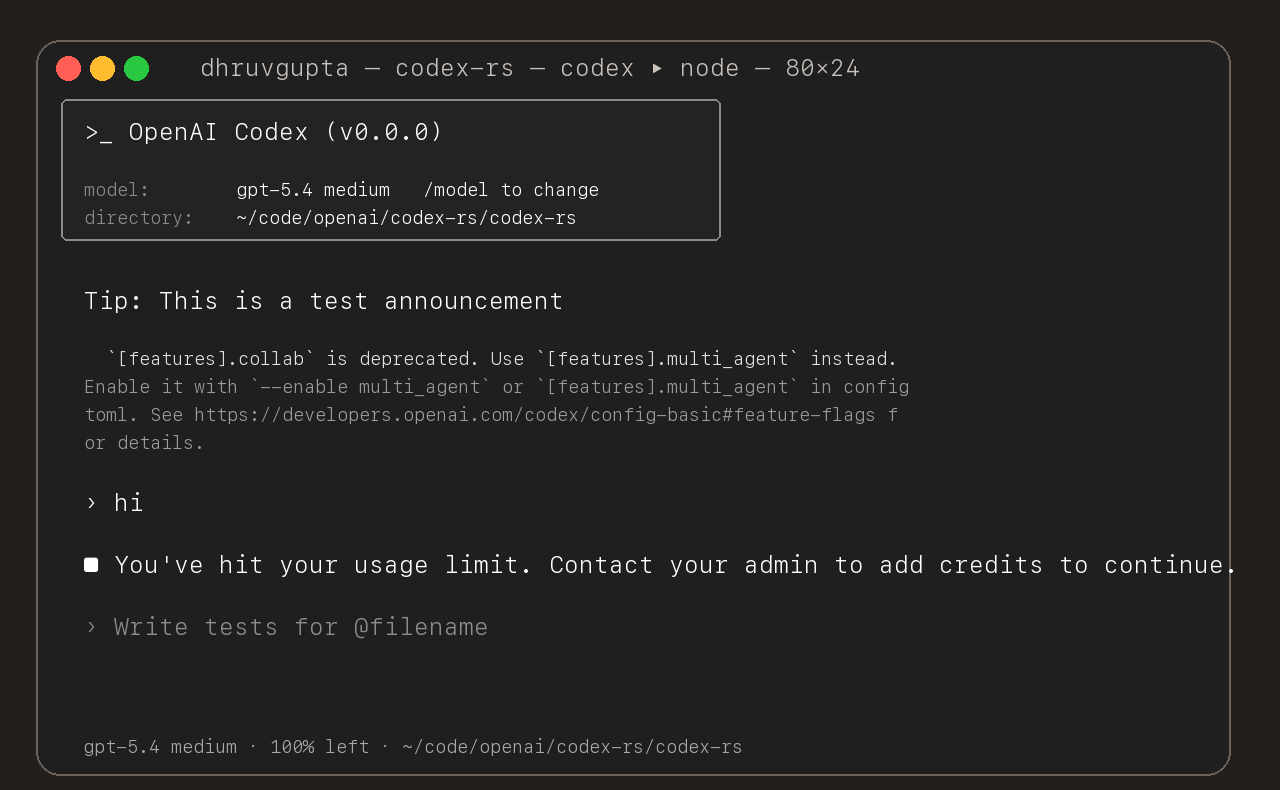
- update the self-serve business usage-based limit message to direct
users to their admin for additional credits
- add a focused unit test for the self_serve_business_usage_based plan
branch
Added also:
If you are at a rate limit but you still have credits, codex cli would
tell you to switch the model. We shouldnt do this if you have credits so
fixed this.
## Test
- launched the source-built CLI and verified the updated message is
shown for the self-serve business usage-based plan
## Summary
- add `ForkSnapshotMode` to `ThreadManager::fork_thread` so callers can
request either a committed snapshot or an interrupted snapshot
- share the model-visible `<turn_aborted>` history marker between the
live interrupt path and interrupted forks
- update the small set of direct fork callsites to pass
`ForkSnapshotMode::Committed`

Note: this enables /btw to work similarly as Esc to interrupt (hopefully
somewhat in distribution)

---------

Co-authored-by: Codex <noreply@openai.com>
## Summary
Adds support for approvals_reviewer to `Op::UserTurn` so we can migrate
`[CodexMessageProcessor::turn_start]` to use Op::UserTurn

## Testing
- [x] Adds quick test for the new field

Co-authored-by: Codex <noreply@openai.com>
- add `PreToolUse` hook for bash-like tool execution only at first
- block shell execution before dispatch with deny-only hook behavior
- introduces common.rs matcher framework for matching when hooks are run

example run:

```
› run three parallel echo commands, and the second one should echo "[block-pre-tool-use]" as a test


• Running the three echo commands in parallel now and I’ll report the output directly.

• Running PreToolUse hook: name for demo pre tool use hook

• Running PreToolUse hook: name for demo pre tool use hook

• Running PreToolUse hook: name for demo pre tool use hook

PreToolUse hook (completed)
  warning: wizard-tower PreToolUse demo inspected Bash: echo "first parallel echo"

PreToolUse hook (blocked)
  warning: wizard-tower PreToolUse demo blocked a Bash command on purpose.
  feedback: PreToolUse demo blocked the command. Remove [block-pre-tool-use] to continue.

PreToolUse hook (completed)
  warning: wizard-tower PreToolUse demo inspected Bash: echo "third parallel echo"

• Ran echo "first parallel echo"
  └ first parallel echo

• Ran echo "third parallel echo"
  └ third parallel echo

• Three little waves went out in parallel.

  1. printed first parallel echo
  2. was blocked before execution because it contained the exact test string [block-pre-tool-use]
  3. printed third parallel echo

  There was also an unrelated macOS defaults warning around the successful commands, but the echoes
  themselves worked fine. If you want, I can rerun the second one with a slightly modified string so
  it passes cleanly.
```
## Summary
- route /realtime, Ctrl+C, and deleted realtime meters through the same
realtime stop path
- keep generic transcription placeholder cleanup free of realtime
shutdown side effects

## Testing
- Ran
- Relied on CI for verification; did not run local tests

---------

Co-authored-by: Codex <noreply@openai.com>
## Summary
- queue input after the user submits `/compact` until that manual
compact turn ends
- mirror the same behavior in the app-server TUI
- add regressions for input queued before compact starts and while it is
running

Co-authored-by: Codex <noreply@openai.com>
- Duplicate app mentions are now suppressed when they’re plugin-backed
with the same display name.
- Remaining connector mentions now label category as [Plugin] when
plugin metadata is present, otherwise [App].
- Mention result lists are now capped to 8 rows after filtering.
- Updates both tui and tui_app_server with the same changes.
## Why

Fixes [#15283](https://github.com/openai/codex/issues/15283), where
sandboxed tool calls fail on older distro `bubblewrap` builds because
`/usr/bin/bwrap` does not understand `--argv0`. The upstream [bubblewrap
v0.9.0 release
notes](https://github.com/containers/bubblewrap/releases/tag/v0.9.0)
explicitly call out `Add --argv0`. Flipping `use_legacy_landlock`
globally works around that compatibility bug, but it also weakens the
default Linux sandbox and breaks proxy-routed and split-policy cases
called out in review.

The follow-up Linux CI failure was in the new launcher test rather than
the launcher logic: the fake `bwrap` helper stayed open for writing, so
Linux would not exec it. This update also closes the user-visibility gap
from review by surfacing the same startup warning when `/usr/bin/bwrap`
is present but too old for `--argv0`, not only when it is missing.

## What Changed

- keep `use_legacy_landlock` default-disabled
- teach `codex-rs/linux-sandbox/src/launcher.rs` to fall back to the
vendored bubblewrap build when `/usr/bin/bwrap` does not advertise
`--argv0` support
- add launcher tests for supported, unsupported, and missing system
`bwrap`
- write the fake `bwrap` test helper to a closed temp path so the
supported-path launcher test works on Linux too
- extend the startup warning path so Codex warns when `/usr/bin/bwrap`
is missing or too old to support `--argv0`
- mirror the warning/fallback wording across
`codex-rs/linux-sandbox/README.md` and `codex-rs/core/README.md`,
including that the fallback is the vendored bubblewrap compiled into the
binary
- cite the upstream `bubblewrap` release that introduced `--argv0`

## Verification

- `bazel test --config=remote --platforms=//:rbe
//codex-rs/linux-sandbox:linux-sandbox-unit-tests
--test_filter=launcher::tests::prefers_system_bwrap_when_help_lists_argv0
--test_output=errors`
- `cargo test -p codex-core system_bwrap_warning`
- `cargo check -p codex-exec -p codex-tui -p codex-tui-app-server -p
codex-app-server`
- `just argument-comment-lint`
## Summary
- use Shift+Left to edit the most recent queued message when running
under tmux
- mirror the same binding change in the app-server TUI
- add tmux-specific tests and snapshot coverage for the rendered
queued-message hint

## Testing
- just fmt
- cargo test -p codex-tui
- cargo test -p codex-tui-app-server
- just argument-comment-lint -p codex-tui -p codex-tui-app-server

Co-authored-by: Codex <noreply@openai.com>
### Preliminary /plugins TUI menu
- Adds a preliminary /plugins menu flow in both tui and tui_app_server.
- Fetches plugin list data asynchronously and shows loading/error/cached
states.
  - Limits this first pass to the curated ChatGPT marketplace.
  - Shows available plugins with installed/status metadata.
- Supports in-menu search over plugin display name, plugin id, plugin
name, and marketplace label.
- Opens a plugin detail view on selection, including summaries for
Skills, Apps, and MCP Servers, with back navigation.

### Testing
  - Launch codex-cli with plugins enabled (`--enable plugins`).
  - Run /plugins and verify:
      - loading state appears first
      - plugin list is shown
      - search filters results
- selecting a plugin opens detail view, with a list of
skills/connectors/MCP servers for the plugin
      - back action returns to the list.
- Verify disabled behavior by running /plugins without plugins enabled
(shows “Plugins are disabled” message).
- Launch with `--enable tui_app_server` (and plugins enabled) and repeat
the same /plugins flow; behavior should match.
## Why
The argument-comment lint now has a packaged DotSlash artifact from
[#15198](https://github.com/openai/codex/pull/15198), so the normal repo
lint path should use that released payload instead of rebuilding the
lint from source every time.

That keeps `just clippy` and CI aligned with the shipped artifact while
preserving a separate source-build path for people actively hacking on
the lint crate.

The current alpha package also exposed two integration wrinkles that the
repo-side prebuilt wrapper needs to smooth over:
- the bundled Dylint library filename includes the host triple, for
example `@nightly-2025-09-18-aarch64-apple-darwin`, and Dylint derives
`RUSTUP_TOOLCHAIN` from that filename
- on Windows, Dylint's driver path also expects `RUSTUP_HOME` to be
present in the environment

Without those adjustments, the prebuilt CI jobs fail during `cargo
metadata` or driver setup. This change makes the checked-in prebuilt
wrapper normalize the packaged library name to the plain
`nightly-2025-09-18` channel before invoking `cargo-dylint`, and it
teaches both the wrapper and the packaged runner source to infer
`RUSTUP_HOME` from `rustup show home` when the environment does not
already provide it.

After the prebuilt Windows lint job started running successfully, it
also surfaced a handful of existing anonymous literal callsites in
`windows-sandbox-rs`. This PR now annotates those callsites so the new
cross-platform lint job is green on the current tree.

## What Changed
- checked in the current
`tools/argument-comment-lint/argument-comment-lint` DotSlash manifest
- kept `tools/argument-comment-lint/run.sh` as the source-build wrapper
for lint development
- added `tools/argument-comment-lint/run-prebuilt-linter.sh` as the
normal enforcement path, using the checked-in DotSlash package and
bundled `cargo-dylint`
- updated `just clippy` and `just argument-comment-lint` to use the
prebuilt wrapper
- split `.github/workflows/rust-ci.yml` so source-package checks live in
a dedicated `argument_comment_lint_package` job, while the released lint
runs in an `argument_comment_lint_prebuilt` matrix on Linux, macOS, and
Windows
- kept the pinned `nightly-2025-09-18` toolchain install in the prebuilt
CI matrix, since the prebuilt package still relies on rustup-provided
toolchain components
- updated `tools/argument-comment-lint/run-prebuilt-linter.sh` to
normalize host-qualified nightly library filenames, keep the `rustup`
shim directory ahead of direct toolchain `cargo` binaries, and export
`RUSTUP_HOME` when needed for Windows Dylint driver setup
- updated `tools/argument-comment-lint/src/bin/argument-comment-lint.rs`
so future published DotSlash artifacts apply the same nightly-filename
normalization and `RUSTUP_HOME` inference internally
- fixed the remaining Windows lint violations in
`codex-rs/windows-sandbox-rs` by adding the required `/*param*/`
comments at the reported callsites
- documented the checked-in DotSlash file, wrapper split, archive
layout, nightly prerequisite, and Windows `RUSTUP_HOME` requirement in
`tools/argument-comment-lint/README.md`
- Split the feature system into a new `codex-features` crate.
- Cut `codex-core` and workspace consumers over to the new config and
warning APIs.

Co-authored-by: Ahmed Ibrahim <219906144+aibrahim-oai@users.noreply.github.com>
Co-authored-by: Codex <noreply@openai.com>
- Move the auth implementation and token data into codex-login.
- Keep codex-core re-exporting that surface from codex-login for
existing callers.

---------

Co-authored-by: Codex <noreply@openai.com>


