## Summary
- reduce public module visibility across Rust crates, preferring private
or crate-private modules with explicit crate-root public exports
- update external call sites and tests to use the intended public crate
APIs instead of reaching through module trees
- add the module visibility guideline to AGENTS.md

## Validation
- `cargo check --workspace --all-targets --message-format=short` passed
before the final fix/format pass
- `just fix` completed successfully
- `just fmt` completed successfully
- `git diff --check` passed
## Description

Add requirements.toml support for `allowed_approvals_reviewers =
["user", "guardian_subagent"]`, so admins can now restrict the use of
guardian mode.

Note: If a user sets a reviewer that isn’t allowed by requirements.toml,
config loading falls back to the first allowed reviewer and emits a
startup warning.

The table below describes the possible admin controls.
| Admin intent | `requirements.toml` | User `config.toml` | End result |
|---|---|---|---|
| Leave Guardian optional | omit `allowed_approvals_reviewers` or set
`["user", "guardian_subagent"]` | user chooses `approvals_reviewer =
"user"` or `"guardian_subagent"` | Guardian off for `user`, on for
`guardian_subagent` + `approval_policy = "on-request"` |
| Force Guardian off | `allowed_approvals_reviewers = ["user"]` | any
user value | Effective reviewer is `user`; Guardian off |
| Force Guardian on | `allowed_approvals_reviewers =
["guardian_subagent"]` and usually `allowed_approval_policies =
["on-request"]` | any user reviewer value; user should also have
`approval_policy = "on-request"` unless policy is forced | Effective
reviewer is `guardian_subagent`; Guardian on when effective approval
policy is `on-request` |
| Allow both, but default to manual if user does nothing |
`allowed_approvals_reviewers = ["user", "guardian_subagent"]` | omit
`approvals_reviewer` | Effective reviewer is `user`; Guardian off |
| Allow both, and user explicitly opts into Guardian |
`allowed_approvals_reviewers = ["user", "guardian_subagent"]` |
`approvals_reviewer = "guardian_subagent"` and `approval_policy =
"on-request"` | Guardian on |
| Invalid admin config | `allowed_approvals_reviewers = []` | anything |
Config load error |
- Keep only parent system/developer/user messages plus assistant
final-answer messages in forked child history.
- Strip parent tool/reasoning items and remove the unmatched synthetic
spawn output.
Stacked on #16508.

This removes the temporary `codex-core` / `codex-login` re-export shims
from the ownership split and rewrites callsites to import directly from
`codex-model-provider-info`, `codex-models-manager`, `codex-api`,
`codex-protocol`, `codex-feedback`, and `codex-response-debug-context`.

No behavior change intended; this is the mechanical import cleanup layer
split out from the ownership move.

---------

Co-authored-by: Codex <noreply@openai.com>
## Summary
- split `models-manager` out of `core` and add `ModelsManagerConfig`
plus `Config::to_models_manager_config()` so model metadata paths stop
depending on `core::Config`
- move login-owned/auth-owned code out of `core` into `codex-login`,
move model provider config into `codex-model-provider-info`, move API
bridge mapping into `codex-api`, move protocol-owned types/impls into
`codex-protocol`, and move response debug helpers into a dedicated
`response-debug-context` crate
- move feedback tag emission into `codex-feedback`, relocate tests to
the crates that now own the code, and keep broad temporary re-exports so
this PR avoids a giant import-only rewrite

## Major moves and decisions
- created `codex-models-manager` as the owner for model
cache/catalog/config/model info logic, including the new
`ModelsManagerConfig` struct
- created `codex-model-provider-info` as the owner for provider config
parsing/defaults and kept temporary `codex-login`/`codex-core`
re-exports for old import paths
- moved `api_bridge` error mapping + `CoreAuthProvider` into
`codex-api`, while `codex-login::api_bridge` temporarily re-exports
those symbols and keeps the `auth_provider_from_auth` wrapper
- moved `auth_env_telemetry` and `provider_auth` ownership to
`codex-login`
- moved `CodexErr` ownership to `codex-protocol::error`, plus
`StreamOutput`, `bytes_to_string_smart`, and network policy helpers to
protocol-owned modules
- created `codex-response-debug-context` for
`extract_response_debug_context`, `telemetry_transport_error_message`,
and related response-debug plumbing instead of leaving that behavior in
`core`
- moved `FeedbackRequestTags`, `emit_feedback_request_tags`, and
`emit_feedback_request_tags_with_auth_env` to `codex-feedback`
- deferred removal of temporary re-exports and the mechanical import
rewrites to a stacked follow-up PR so this PR stays reviewable

## Test moves
- moved auth refresh coverage from `core/tests/suite/auth_refresh.rs` to
`login/tests/suite/auth_refresh.rs`
- moved text encoding coverage from
`core/tests/suite/text_encoding_fix.rs` to
`protocol/src/exec_output_tests.rs`
- moved model info override coverage from
`core/tests/suite/model_info_overrides.rs` to
`models-manager/src/model_info_overrides_tests.rs`

---------

Co-authored-by: Codex <noreply@openai.com>
## Why

`codex-core` was re-exporting APIs owned by sibling `codex-*` crates,
which made downstream crates depend on `codex-core` as a proxy module
instead of the actual owner crate.

Removing those forwards makes crate boundaries explicit and lets leaf
crates drop unnecessary `codex-core` dependencies. In this PR, this
reduces the dependency on `codex-core` to `codex-login` in the following
files:

```
codex-rs/backend-client/Cargo.toml
codex-rs/mcp-server/tests/common/Cargo.toml
```

## What

- Remove `codex-rs/core/src/lib.rs` re-exports for symbols owned by
`codex-login`, `codex-mcp`, `codex-rollout`, `codex-analytics`,
`codex-protocol`, `codex-shell-command`, `codex-sandboxing`,
`codex-tools`, and `codex-utils-path`.
- Delete the `default_client` forwarding shim in `codex-rs/core`.
- Update in-crate and downstream callsites to import directly from the
owning `codex-*` crate.
- Add direct Cargo dependencies where callsites now target the owner
crate, and remove `codex-core` from `codex-rs/backend-client`.
Adds this:
```
properties.insert(
            "fork_turns".to_string(),
            JsonSchema::String {
                description: Some(
                    "Optional MultiAgentV2 fork mode. Use `none`, `all`, or a positive integer string such as `3` to fork only the most recent turns."
                        .to_string(),
                ),
            },
        );
        ```

---------

Co-authored-by: Codex <noreply@openai.com>
## Why

`argument-comment-lint` was green in CI even though the repo still had
many uncommented literal arguments. The main gap was target coverage:
the repo wrapper did not force Cargo to inspect test-only call sites, so
examples like the `latest_session_lookup_params(true, ...)` tests in
`codex-rs/tui_app_server/src/lib.rs` never entered the blocking CI path.

This change cleans up the existing backlog, makes the default repo lint
path cover all Cargo targets, and starts rolling that stricter CI
enforcement out on the platform where it is currently validated.

## What changed

- mechanically fixed existing `argument-comment-lint` violations across
the `codex-rs` workspace, including tests, examples, and benches
- updated `tools/argument-comment-lint/run-prebuilt-linter.sh` and
`tools/argument-comment-lint/run.sh` so non-`--fix` runs default to
`--all-targets` unless the caller explicitly narrows the target set
- fixed both wrappers so forwarded cargo arguments after `--` are
preserved with a single separator
- documented the new default behavior in
`tools/argument-comment-lint/README.md`
- updated `rust-ci` so the macOS lint lane keeps the plain wrapper
invocation and therefore enforces `--all-targets`, while Linux and
Windows temporarily pass `-- --lib --bins`

That temporary CI split keeps the stricter all-targets check where it is
already cleaned up, while leaving room to finish the remaining Linux-
and Windows-specific target-gated cleanup before enabling
`--all-targets` on those runners. The Linux and Windows failures on the
intermediate revision were caused by the wrapper forwarding bug, not by
additional lint findings in those lanes.

## Validation

- `bash -n tools/argument-comment-lint/run.sh`
- `bash -n tools/argument-comment-lint/run-prebuilt-linter.sh`
- shell-level wrapper forwarding check for `-- --lib --bins`
- shell-level wrapper forwarding check for `-- --tests`
- `just argument-comment-lint`
- `cargo test` in `tools/argument-comment-lint`
- `cargo test -p codex-terminal-detection`

## Follow-up

- Clean up remaining Linux-only target-gated callsites, then switch the
Linux lint lane back to the plain wrapper invocation.
- Clean up remaining Windows-only target-gated callsites, then switch
the Windows lint lane back to the plain wrapper invocation.
Add environment manager that is a singleton and is created early in
app-server (before skill manager, before config loading).

Use an environment variable to point to a running exec server.
## Summary
- move skill loading and management into codex-core-skills
- leave codex-core with the thin integration layer and shared wiring

## Testing
- CI

---------

Co-authored-by: Codex <noreply@openai.com>
Migrate `cwd` and related session/config state to `AbsolutePathBuf` so
downstream consumers consistently see absolute working directories.

Add test-only `.abs()` helpers for `Path`, `PathBuf`, and `TempDir`, and
update branch-local tests to use them instead of
`AbsolutePathBuf::try_from(...)`.

For the remaining TUI/app-server snapshot coverage that renders absolute
cwd values, keep the snapshots unchanged and skip the Windows-only cases
where the platform-specific absolute path layout differs.
Make the inter-agent communication start a turn

As part of this, we disable the v2 notifier to prevent some odd
behaviour where the agent restart working while you're talking to it for
example
Show all plugin marketplaces in the /plugins popup by removing the
`openai-curated` marketplace filter, and update plugin popup
copy/tests/snapshots to match the new behavior in both TUI codepaths.
## Summary
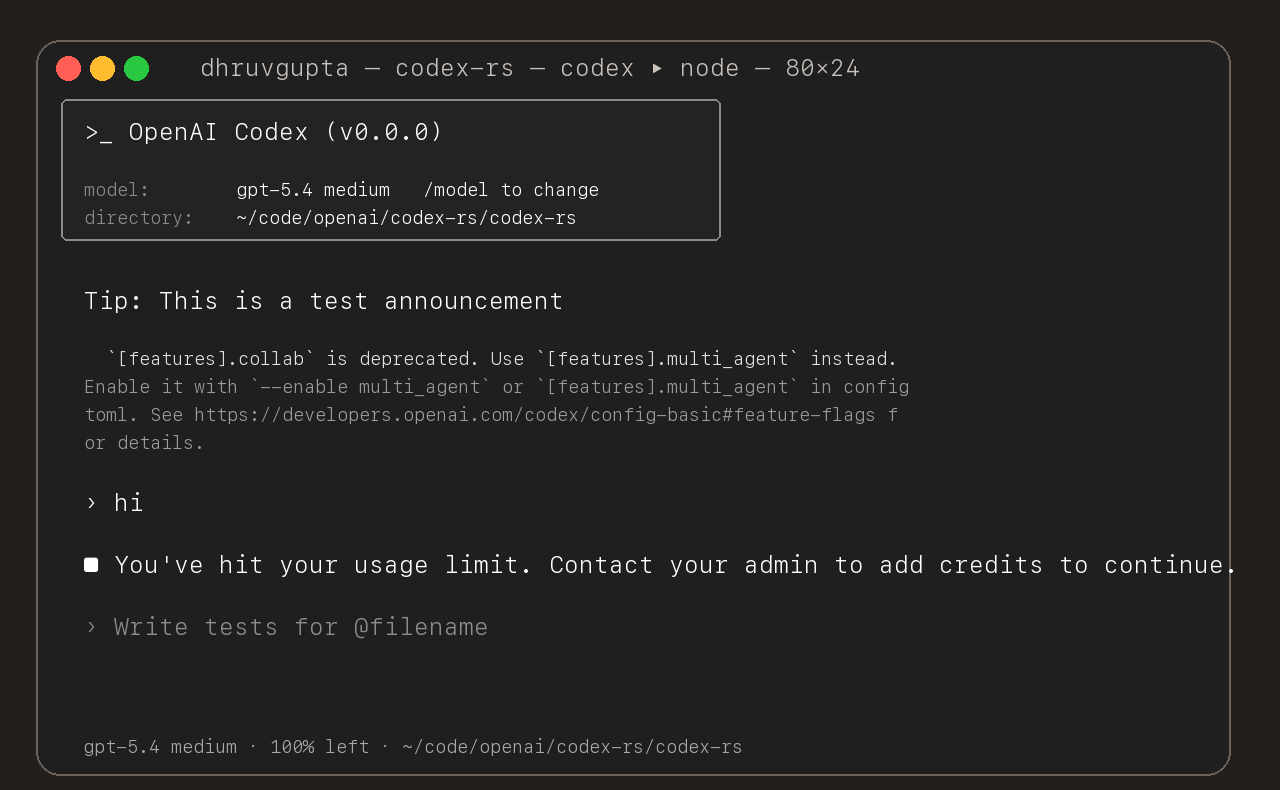
- update the self-serve business usage-based limit message to direct
users to their admin for additional credits
- add a focused unit test for the self_serve_business_usage_based plan
branch
Added also:
If you are at a rate limit but you still have credits, codex cli would
tell you to switch the model. We shouldnt do this if you have credits so
fixed this.
## Test
- launched the source-built CLI and verified the updated message is
shown for the self-serve business usage-based plan
Send input now sends messages as assistant message and with this format:

```
author: /root/worker_a
recipient: /root/worker_a/tester
other_recipients: []
Content: bla bla bla. Actual content. Only text for now
```
This PR add an URI-based system to reference agents within a tree. This
comes from a sync between research and engineering.

The main agent (the one manually spawned by a user) is always called
`/root`. Any sub-agent spawned by it will be `/root/agent_1` for example
where `agent_1` is chosen by the model.

Any agent can contact any agents using the path.

Paths can be used either in absolute or relative to the calling agents

Resume is not supported for now on this new path
- Split the feature system into a new `codex-features` crate.
- Cut `codex-core` and workspace consumers over to the new config and
warning APIs.

Co-authored-by: Ahmed Ibrahim <219906144+aibrahim-oai@users.noreply.github.com>
Co-authored-by: Codex <noreply@openai.com>
Add a representation of the agent graph. This is now used for:
* Cascade close agents (when I close a parent, it close the kids)
* Cascade resume (oposite)

Later, this will also be used for post-compaction stuffing of the
context

Direct fix for: https://github.com/openai/codex/issues/14458
## Summary
If a subagent requests approval, and the user persists that approval to
the execpolicy, it should (by default) propagate. We'll need to rethink
this a bit in light of coming Permissions changes, though I think this
is closer to the end state that we'd want, which is that execpolicy
changes to one permissions profile should be synced across threads.

## Testing
- [x] Added integration test

---------

Co-authored-by: Codex <noreply@openai.com>
This change adds Jason to codex-core's built-in subagent nickname pool
so spawned agents can pick it without any custom role configuration. The
default list was simply missing that predefined name (a grave mistake).
## Why

Once the repo-local lint exists, `codex-rs` needs to follow the
checked-in convention and CI needs to keep it from drifting. This commit
applies the fallback `/*param*/` style consistently across existing
positional literal call sites without changing those APIs.

The longer-term preference is still to avoid APIs that require comments
by choosing clearer parameter types and call shapes. This PR is
intentionally the mechanical follow-through for the places where the
existing signatures stay in place.

After rebasing onto newer `main`, the rollout also had to cover newly
introduced `tui_app_server` call sites. That made it clear the first cut
of the CI job was too expensive for the common path: it was spending
almost as much time installing `cargo-dylint` and re-testing the lint
crate as a representative test job spends running product tests. The CI
update keeps the full workspace enforcement but trims that extra
overhead from ordinary `codex-rs` PRs.

## What changed

- keep a dedicated `argument_comment_lint` job in `rust-ci`
- mechanically annotate remaining opaque positional literals across
`codex-rs` with exact `/*param*/` comments, including the rebased
`tui_app_server` call sites that now fall under the lint
- keep the checked-in style aligned with the lint policy by using
`/*param*/` and leaving string and char literals uncommented
- cache `cargo-dylint`, `dylint-link`, and the relevant Cargo
registry/git metadata in the lint job
- split changed-path detection so the lint crate's own `cargo test` step
runs only when `tools/argument-comment-lint/*` or `rust-ci.yml` changes
- continue to run the repo wrapper over the `codex-rs` workspace, so
product-code enforcement is unchanged

Most of the code changes in this commit are intentionally mechanical
comment rewrites or insertions driven by the lint itself.

## Verification

- `./tools/argument-comment-lint/run.sh --workspace`
- `cargo test -p codex-tui-app-server -p codex-tui`
- parsed `.github/workflows/rust-ci.yml` locally with PyYAML

---

* -> #14652
* #14651
Make `interrupted` an agent state and make it not final. As a result, a
`wait` won't return on an interrupted agent and no notification will be
send to the parent agent.

The rationals are:
* If a user interrupt a sub-agent for any reason, you don't want the
parent agent to instantaneously ask the sub-agent to restart
* If a parent agent interrupt a sub-agent, no need to add a noisy
notification in the parent agen
## Why
PR #13783 moved the `codex.rs` unit tests into `codex_tests.rs`. This
applies the same extraction pattern across the rest of `codex-rs/core`
so the production modules stay focused on runtime code instead of large
inline test blocks.

Keeping the tests in sibling files also makes follow-up edits easier to
review because product changes no longer have to share a file with
hundreds or thousands of lines of test scaffolding.

## What changed
- replaced each inline `mod tests { ... }` in `codex-rs/core/src/**`
with a path-based module declaration
- moved each extracted unit test module into a sibling `*_tests.rs`
file, using `mod_tests.rs` for `mod.rs` modules
- preserved the existing `cfg(...)` guards and module-local structure so
the refactor remains structural rather than behavioral

## Testing
- `cargo test -p codex-core --lib` (`1653 passed; 0 failed; 5 ignored`)
- `just fix -p codex-core`
- `cargo fmt --check`
- `cargo shear`
## Why

to support a new bring your own search tool in Responses
API(https://developers.openai.com/api/docs/guides/tools-tool-search#client-executed-tool-search)
we migrating our bm25 search tool to use official way to execute search
on client and communicate additional tools to the model.

## What
- replace the legacy `search_tool_bm25` flow with client-executed
`tool_search`
- add protocol, SSE, history, and normalization support for
`tool_search_call` and `tool_search_output`
- return namespaced Codex Apps search results and wire namespaced
follow-up tool calls back into MCP dispatch
- tell agents when a role pins model or reasoning effort so they know
those settings are not changeable
- add prompt-builder coverage for the locked-setting notes


