Add environment manager that is a singleton and is created early in
app-server (before skill manager, before config loading).

Use an environment variable to point to a running exec server.
## Summary
- add `codex resume --include-non-interactive` to include
non-interactive sessions in the picker and `--last`
- keep current-provider and cwd filtering behavior unchanged
- replace the picker API boolean with a `SessionSourceFilter` enum to
avoid a boolean trap

## Tests
- `cargo test -p codex-cli`
- `cargo test -p codex-tui`
- `just fmt`
- `just fix -p codex-cli`
- `just fix -p codex-tui`
Migrate `cwd` and related session/config state to `AbsolutePathBuf` so
downstream consumers consistently see absolute working directories.

Add test-only `.abs()` helpers for `Path`, `PathBuf`, and `TempDir`, and
update branch-local tests to use them instead of
`AbsolutePathBuf::try_from(...)`.

For the remaining TUI/app-server snapshot coverage that renders absolute
cwd values, keep the snapshots unchanged and skip the Windows-only cases
where the platform-specific absolute path layout differs.
- Removes provenance filtering in the mentions feature for apps and
skills that were installed as part of a plugin.
- All skills and apps for a plugin are mentionable with this change.
## Summary

Fixes early TUI exit paths that could leave the terminal in a dirty
state and cause a stray `%` prompt marker after the app quit.

## Root cause

Both `tui` and `tui_app_server` had early returns after `tui::init()`
that did not guarantee terminal restore. When that happened, shells like
`zsh` inherited the altered terminal state.

## Changes

- Add a restore guard around `run_ratatui_app()` in both `tui` and
`tui_app_server`
- Route early exits through the guard instead of relying on scattered
manual restore calls
- Ensure terminal restore still happens on normal shutdown
- Remove marketplace from left column.
- Change `Can be installed` to `Available`
- Align right-column marketplace + selected-row hint text across states.
- Changes applied to both `tui` and `tui_app_server`.
- Update related snapshots/tests.


<img width="2142" height="590" alt="image"
src="https://github.com/user-attachments/assets/6e60b783-2bea-46d4-b353-f2fd328ac4d0"
/>
- create `codex-git-utils` and move the shared git helpers into it with
file moves preserved for diff readability
- move the `GitInfo` helpers out of `core` so stacked rollout work can
depend on the shared crate without carrying its own git info module

---------

Co-authored-by: Ahmed Ibrahim <219906144+aibrahim-oai@users.noreply.github.com>
Co-authored-by: Codex <noreply@openai.com>
- Remove numeric prefixes for disabled rows in shared list rendering.
These numbers are shortcuts, Ex: Pressing "2" selects option `#2`.
Disabled items can not be selected, so keeping numbers on these items is
misleading.
- Apply the same behavior in both tui and tui_app_server.
- Update affected snapshots for apps/plugins loading and plugin detail
rows.

_**This is a global change.**_

Before:
<img width="1680" height="488" alt="image"
src="https://github.com/user-attachments/assets/4bcf94ad-285f-48d3-a235-a85b58ee58e2"
/>

After:
<img width="1706" height="484" alt="image"
src="https://github.com/user-attachments/assets/76bb6107-a562-42fe-ae94-29440447ca77"
/>
- Prefer plugin manifest `interface.displayName` for plugin labels.
- Preserve plugin provenance when handling `list_mcp_tools` so connector
`plugin_display_names` are not clobbered.
- Add a TUI test to ensure plugin-owned app mentions are deduped
correctly.
Updates plugin ordering so installed plugins are listed first, with
alphabetical sorting applied within the installed and uninstalled
groups. The behavior is now consistent across both `tui` and
`tui_app_server`, and related tests/snapshots were updated.
This PR completes the conversion of non-interactive `codex exec` to use
app server rather than directly using core events and methods.

### Summary
- move `codex-exec` off exec-owned `AuthManager` and `ThreadManager`
state
- route exec bootstrap, resume, and auth refresh through existing
app-server paths
- replace legacy `codex/event/*` decoding in exec with typed app-server
notification handling
- update human and JSONL exec output adapters to translate existing
app-server notifications only
- clean up "app server client" layer by eliminating support for legacy
notifications; this is no longer needed
- remove exposure of `authManager` and `threadManager` from "app server
client" layer

### Testing
- `exec` has pretty extensive unit and integration tests already, and
these all pass
- In addition, I asked Codex to put together a comprehensive manual set
of tests to cover all of the `codex exec` functionality (including
command-line options), and it successfully generated and ran these tests
Show all plugin marketplaces in the /plugins popup by removing the
`openai-curated` marketplace filter, and update plugin popup
copy/tests/snapshots to match the new behavior in both TUI codepaths.
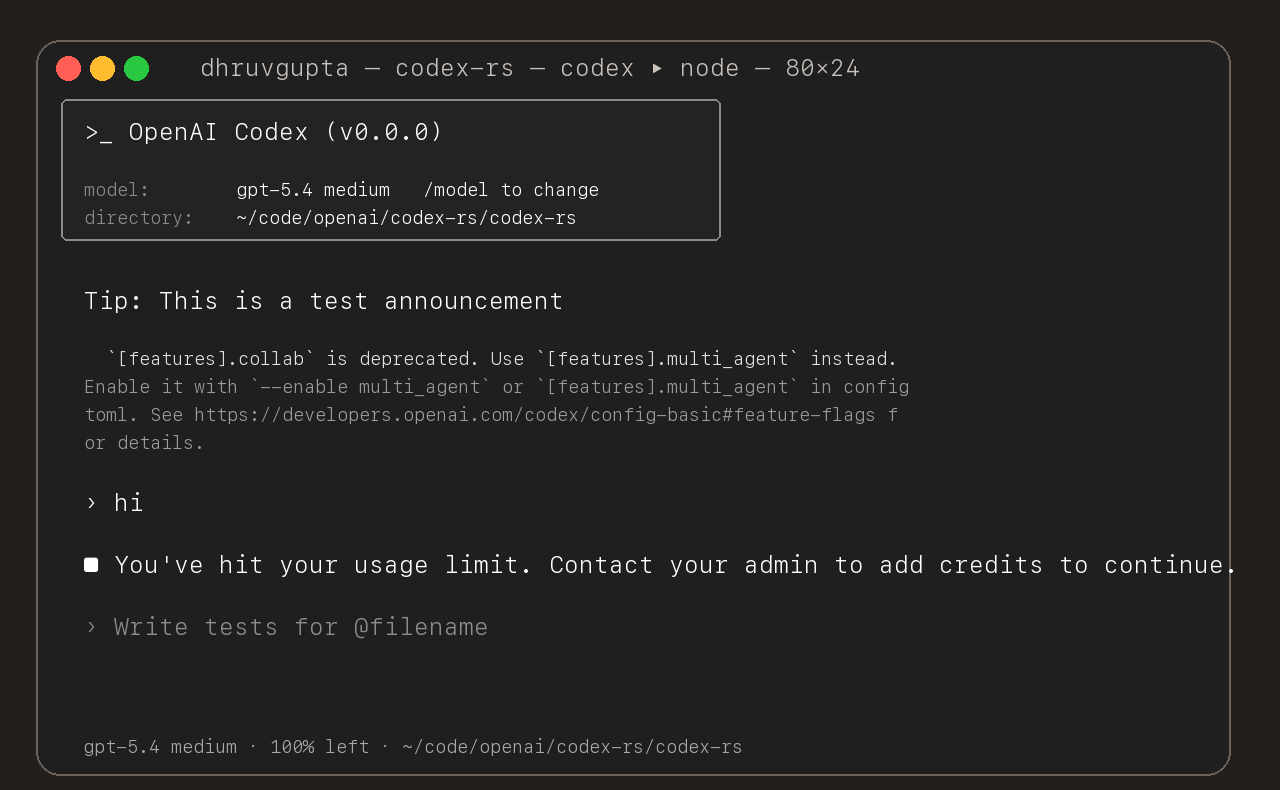
## Summary
- update the self-serve business usage-based limit message to direct
users to their admin for additional credits
- add a focused unit test for the self_serve_business_usage_based plan
branch
Added also:
If you are at a rate limit but you still have credits, codex cli would
tell you to switch the model. We shouldnt do this if you have credits so
fixed this.
## Test
- launched the source-built CLI and verified the updated message is
shown for the self-serve business usage-based plan
## Summary
- add `ForkSnapshotMode` to `ThreadManager::fork_thread` so callers can
request either a committed snapshot or an interrupted snapshot
- share the model-visible `<turn_aborted>` history marker between the
live interrupt path and interrupted forks
- update the small set of direct fork callsites to pass
`ForkSnapshotMode::Committed`

Note: this enables /btw to work similarly as Esc to interrupt (hopefully
somewhat in distribution)

---------

Co-authored-by: Codex <noreply@openai.com>
## Summary
Adds support for approvals_reviewer to `Op::UserTurn` so we can migrate
`[CodexMessageProcessor::turn_start]` to use Op::UserTurn

## Testing
- [x] Adds quick test for the new field

Co-authored-by: Codex <noreply@openai.com>
- add `PreToolUse` hook for bash-like tool execution only at first
- block shell execution before dispatch with deny-only hook behavior
- introduces common.rs matcher framework for matching when hooks are run

example run:

```
› run three parallel echo commands, and the second one should echo "[block-pre-tool-use]" as a test


• Running the three echo commands in parallel now and I’ll report the output directly.

• Running PreToolUse hook: name for demo pre tool use hook

• Running PreToolUse hook: name for demo pre tool use hook

• Running PreToolUse hook: name for demo pre tool use hook

PreToolUse hook (completed)
  warning: wizard-tower PreToolUse demo inspected Bash: echo "first parallel echo"

PreToolUse hook (blocked)
  warning: wizard-tower PreToolUse demo blocked a Bash command on purpose.
  feedback: PreToolUse demo blocked the command. Remove [block-pre-tool-use] to continue.

PreToolUse hook (completed)
  warning: wizard-tower PreToolUse demo inspected Bash: echo "third parallel echo"

• Ran echo "first parallel echo"
  └ first parallel echo

• Ran echo "third parallel echo"
  └ third parallel echo

• Three little waves went out in parallel.

  1. printed first parallel echo
  2. was blocked before execution because it contained the exact test string [block-pre-tool-use]
  3. printed third parallel echo

  There was also an unrelated macOS defaults warning around the successful commands, but the echoes
  themselves worked fine. If you want, I can rerun the second one with a slightly modified string so
  it passes cleanly.
```
## Summary
- route /realtime, Ctrl+C, and deleted realtime meters through the same
realtime stop path
- keep generic transcription placeholder cleanup free of realtime
shutdown side effects

## Testing
- Ran
- Relied on CI for verification; did not run local tests

---------

Co-authored-by: Codex <noreply@openai.com>
## Summary
- queue input after the user submits `/compact` until that manual
compact turn ends
- mirror the same behavior in the app-server TUI
- add regressions for input queued before compact starts and while it is
running

Co-authored-by: Codex <noreply@openai.com>
- Duplicate app mentions are now suppressed when they’re plugin-backed
with the same display name.
- Remaining connector mentions now label category as [Plugin] when
plugin metadata is present, otherwise [App].
- Mention result lists are now capped to 8 rows after filtering.
- Updates both tui and tui_app_server with the same changes.
## Why

Fixes [#15283](https://github.com/openai/codex/issues/15283), where
sandboxed tool calls fail on older distro `bubblewrap` builds because
`/usr/bin/bwrap` does not understand `--argv0`. The upstream [bubblewrap
v0.9.0 release
notes](https://github.com/containers/bubblewrap/releases/tag/v0.9.0)
explicitly call out `Add --argv0`. Flipping `use_legacy_landlock`
globally works around that compatibility bug, but it also weakens the
default Linux sandbox and breaks proxy-routed and split-policy cases
called out in review.

The follow-up Linux CI failure was in the new launcher test rather than
the launcher logic: the fake `bwrap` helper stayed open for writing, so
Linux would not exec it. This update also closes the user-visibility gap
from review by surfacing the same startup warning when `/usr/bin/bwrap`
is present but too old for `--argv0`, not only when it is missing.

## What Changed

- keep `use_legacy_landlock` default-disabled
- teach `codex-rs/linux-sandbox/src/launcher.rs` to fall back to the
vendored bubblewrap build when `/usr/bin/bwrap` does not advertise
`--argv0` support
- add launcher tests for supported, unsupported, and missing system
`bwrap`
- write the fake `bwrap` test helper to a closed temp path so the
supported-path launcher test works on Linux too
- extend the startup warning path so Codex warns when `/usr/bin/bwrap`
is missing or too old to support `--argv0`
- mirror the warning/fallback wording across
`codex-rs/linux-sandbox/README.md` and `codex-rs/core/README.md`,
including that the fallback is the vendored bubblewrap compiled into the
binary
- cite the upstream `bubblewrap` release that introduced `--argv0`

## Verification

- `bazel test --config=remote --platforms=//:rbe
//codex-rs/linux-sandbox:linux-sandbox-unit-tests
--test_filter=launcher::tests::prefers_system_bwrap_when_help_lists_argv0
--test_output=errors`
- `cargo test -p codex-core system_bwrap_warning`
- `cargo check -p codex-exec -p codex-tui -p codex-tui-app-server -p
codex-app-server`
- `just argument-comment-lint`
## Summary
- use Shift+Left to edit the most recent queued message when running
under tmux
- mirror the same binding change in the app-server TUI
- add tmux-specific tests and snapshot coverage for the rendered
queued-message hint

## Testing
- just fmt
- cargo test -p codex-tui
- cargo test -p codex-tui-app-server
- just argument-comment-lint -p codex-tui -p codex-tui-app-server

Co-authored-by: Codex <noreply@openai.com>
### Preliminary /plugins TUI menu
- Adds a preliminary /plugins menu flow in both tui and tui_app_server.
- Fetches plugin list data asynchronously and shows loading/error/cached
states.
  - Limits this first pass to the curated ChatGPT marketplace.
  - Shows available plugins with installed/status metadata.
- Supports in-menu search over plugin display name, plugin id, plugin
name, and marketplace label.
- Opens a plugin detail view on selection, including summaries for
Skills, Apps, and MCP Servers, with back navigation.

### Testing
  - Launch codex-cli with plugins enabled (`--enable plugins`).
  - Run /plugins and verify:
      - loading state appears first
      - plugin list is shown
      - search filters results
- selecting a plugin opens detail view, with a list of
skills/connectors/MCP servers for the plugin
      - back action returns to the list.
- Verify disabled behavior by running /plugins without plugins enabled
(shows “Plugins are disabled” message).
- Launch with `--enable tui_app_server` (and plugins enabled) and repeat
the same /plugins flow; behavior should match.
## Why
The argument-comment lint now has a packaged DotSlash artifact from
[#15198](https://github.com/openai/codex/pull/15198), so the normal repo
lint path should use that released payload instead of rebuilding the
lint from source every time.

That keeps `just clippy` and CI aligned with the shipped artifact while
preserving a separate source-build path for people actively hacking on
the lint crate.

The current alpha package also exposed two integration wrinkles that the
repo-side prebuilt wrapper needs to smooth over:
- the bundled Dylint library filename includes the host triple, for
example `@nightly-2025-09-18-aarch64-apple-darwin`, and Dylint derives
`RUSTUP_TOOLCHAIN` from that filename
- on Windows, Dylint's driver path also expects `RUSTUP_HOME` to be
present in the environment

Without those adjustments, the prebuilt CI jobs fail during `cargo
metadata` or driver setup. This change makes the checked-in prebuilt
wrapper normalize the packaged library name to the plain
`nightly-2025-09-18` channel before invoking `cargo-dylint`, and it
teaches both the wrapper and the packaged runner source to infer
`RUSTUP_HOME` from `rustup show home` when the environment does not
already provide it.

After the prebuilt Windows lint job started running successfully, it
also surfaced a handful of existing anonymous literal callsites in
`windows-sandbox-rs`. This PR now annotates those callsites so the new
cross-platform lint job is green on the current tree.

## What Changed
- checked in the current
`tools/argument-comment-lint/argument-comment-lint` DotSlash manifest
- kept `tools/argument-comment-lint/run.sh` as the source-build wrapper
for lint development
- added `tools/argument-comment-lint/run-prebuilt-linter.sh` as the
normal enforcement path, using the checked-in DotSlash package and
bundled `cargo-dylint`
- updated `just clippy` and `just argument-comment-lint` to use the
prebuilt wrapper
- split `.github/workflows/rust-ci.yml` so source-package checks live in
a dedicated `argument_comment_lint_package` job, while the released lint
runs in an `argument_comment_lint_prebuilt` matrix on Linux, macOS, and
Windows
- kept the pinned `nightly-2025-09-18` toolchain install in the prebuilt
CI matrix, since the prebuilt package still relies on rustup-provided
toolchain components
- updated `tools/argument-comment-lint/run-prebuilt-linter.sh` to
normalize host-qualified nightly library filenames, keep the `rustup`
shim directory ahead of direct toolchain `cargo` binaries, and export
`RUSTUP_HOME` when needed for Windows Dylint driver setup
- updated `tools/argument-comment-lint/src/bin/argument-comment-lint.rs`
so future published DotSlash artifacts apply the same nightly-filename
normalization and `RUSTUP_HOME` inference internally
- fixed the remaining Windows lint violations in
`codex-rs/windows-sandbox-rs` by adding the required `/*param*/`
comments at the reported callsites
- documented the checked-in DotSlash file, wrapper split, archive
layout, nightly prerequisite, and Windows `RUSTUP_HOME` requirement in
`tools/argument-comment-lint/README.md`
- Split the feature system into a new `codex-features` crate.
- Cut `codex-core` and workspace consumers over to the new config and
warning APIs.

Co-authored-by: Ahmed Ibrahim <219906144+aibrahim-oai@users.noreply.github.com>
Co-authored-by: Codex <noreply@openai.com>
- Move the auth implementation and token data into codex-login.
- Keep codex-core re-exporting that surface from codex-login for
existing callers.

---------

Co-authored-by: Codex <noreply@openai.com>
- Move core/src/terminal.rs and its tests into a standalone
terminal-detection workspace crate.
- Update direct consumers to depend on codex-terminal-detection and
import terminal APIs directly.

---------

Co-authored-by: Codex <noreply@openai.com>
## Problem

When multiple Codex sessions are open at once, terminal tabs and windows
are hard to distinguish from each other. The existing status line only
helps once the TUI is already focused, so it does not solve the "which
tab is this?" problem.

This PR adds a first-class `/title` command so the terminal window or
tab title can carry a short, configurable summary of the current
session.

## Screenshot

<img width="849" height="320" alt="image"
src="https://github.com/user-attachments/assets/8b112927-7890-45ed-bb1e-adf2f584663d"
/>

## Mental model

`/statusline` and `/title` are separate status surfaces with different
constraints. The status line is an in-app footer that can be denser and
more detailed. The terminal title is external terminal metadata, so it
needs short, stable segments that still make multiple sessions easy to
tell apart.

The `/title` configuration is an ordered list of compact items. By
default it renders `spinner,project`, so active sessions show
lightweight progress first while idle sessions still stay easy to
disambiguate. Each configured item is omitted when its value is not
currently available rather than forcing a placeholder.

## Non-goals

This does not merge `/title` into `/statusline`, and it does not add an
arbitrary free-form title string. The feature is intentionally limited
to a small set of structured items so the title stays short and
reviewable.

This also does not attempt to restore whatever title the terminal or
shell had before Codex started. When Codex clears the title, it clears
the title Codex last wrote.

## Tradeoffs

A separate `/title` command adds some conceptual overlap with
`/statusline`, but it keeps title-specific constraints explicit instead
of forcing the status line model to cover two different surfaces.

Title refresh can happen frequently, so the implementation now shares
parsing and git-branch orchestration between the status line and title
paths, and caches the derived project-root name by cwd. That keeps the
hot path cheap without introducing background polling.

## Architecture

The TUI gets a new `/title` slash command and a dedicated picker UI for
selecting and ordering terminal-title items. The chosen ids are
persisted in `tui.terminal_title`, with `spinner` and `project` as the
default when the config is unset. `status` remains available as a
separate text item, so configurations like `spinner,status` render
compact progress like `⠋ Working`.

`ChatWidget` now refreshes both status surfaces through a shared
`refresh_status_surfaces()` path. That shared path parses configured
items once, warns on invalid ids once, synchronizes shared cached state
such as git-branch lookup, then renders the footer status line and
terminal title from the same snapshot.

Low-level OSC title writes live in `codex-rs/tui/src/terminal_title.rs`,
which owns the terminal write path and last-mile sanitization before
emitting OSC 0.

## Security

Terminal-title text is treated as untrusted display content before Codex
emits it. The write path strips control characters, removes invisible
and bidi formatting characters that can make the title visually
misleading, normalizes whitespace, and caps the emitted length.

References used while implementing this:

- [xterm control
sequences](https://invisible-island.net/xterm/ctlseqs/ctlseqs.html)
- [WezTerm escape sequences](https://wezterm.org/escape-sequences.html)
- [CWE-150: Improper Neutralization of Escape, Meta, or Control
Sequences](https://cwe.mitre.org/data/definitions/150.html)
- [CERT VU#999008 (Trojan Source)](https://kb.cert.org/vuls/id/999008)
- [Trojan Source disclosure site](https://trojansource.codes/)
- [Unicode Bidirectional Algorithm (UAX
#9)](https://www.unicode.org/reports/tr9/)
- [Unicode Security Considerations (UTR
#36)](https://www.unicode.org/reports/tr36/)

## Observability

Unknown configured title item ids are warned about once instead of
repeatedly spamming the transcript. Live preview applies immediately
while the `/title` picker is open, and cancel rolls the in-memory title
selection back to the pre-picker value.

If terminal title writes fail, the TUI emits debug logs around set and
clear attempts. The rendered status label intentionally collapses richer
internal states into compact title text such as `Starting...`, `Ready`,
`Thinking...`, `Working...`, `Waiting...`, and `Undoing...` when
`status` is configured.

## Tests

Ran:

- `just fmt`
- `cargo test -p codex-tui`

At the moment, the red Windows `rust-ci` failures are due to existing
`codex-core` `apply_patch_cli` stack-overflow tests that also reproduce
on `main`. The `/title`-specific `codex-tui` suite is green.
1. Added SessionSource::Custom(String) and --session-source.
  2. Enforced plugin and skill products by session_source.
  3. Applied the same filtering to curated background refresh.
## Summary
- detect custom prompts in `$CODEX_HOME/prompts` during TUI startup
- show a deprecation notice only when prompts are present, with guidance
to use `$skill-creator`
- add TUI tests and snapshot coverage for present, missing, and empty
prompts directories

## Testing
- Manually tested
1. Use requirement-resolved config.features as the plugin gate.
2. Guard plugin/list, plugin/read, and related flows behind that gate.
3. Skip bad marketplace.json files instead of failing the whole list.
4. Simplify plugin state and caching.
- this allows blocking the user's prompts from executing, and also
prevents them from entering history
- handles the edge case where you can both prevent the user's prompt AND
add n amount of additionalContexts
- refactors some old code into common.rs where hooks overlap
functionality
- refactors additionalContext being previously added to user messages,
instead we use developer messages for them
- handles queued messages correctly

Sample hook for testing - if you write "[block-user-submit]" this hook
will stop the thread:

example run
```
› sup


• Running UserPromptSubmit hook: reading the observatory notes

UserPromptSubmit hook (completed)
  warning: wizard-tower UserPromptSubmit demo inspected: sup
  hook context: Wizard Tower UserPromptSubmit demo fired. For this reply only, include the exact
phrase 'observatory lanterns lit' exactly once near the end.

• Just riding the cosmic wave and ready to help, my friend. What are we building today? observatory
  lanterns lit


› and [block-user-submit]


• Running UserPromptSubmit hook: reading the observatory notes

UserPromptSubmit hook (stopped)
  warning: wizard-tower UserPromptSubmit demo blocked the prompt on purpose.
  stop: Wizard Tower demo block: remove [block-user-submit] to continue.
```

.codex/config.toml
```
[features]
codex_hooks = true
```

.codex/hooks.json
```
{
  "hooks": {
    "UserPromptSubmit": [
      {
        "hooks": [
          {
            "type": "command",
            "command": "/usr/bin/python3 .codex/hooks/user_prompt_submit_demo.py",
            "timeoutSec": 10,
            "statusMessage": "reading the observatory notes"
          }
        ]
      }
    ]
  }
}
```

.codex/hooks/user_prompt_submit_demo.py
```
#!/usr/bin/env python3

import json
import sys
from pathlib import Path


def prompt_from_payload(payload: dict) -> str:
    prompt = payload.get("prompt")
    if isinstance(prompt, str) and prompt.strip():
        return prompt.strip()

    event = payload.get("event")
    if isinstance(event, dict):
        user_prompt = event.get("user_prompt")
        if isinstance(user_prompt, str):
            return user_prompt.strip()

    return ""


def main() -> int:
    payload = json.load(sys.stdin)
    prompt = prompt_from_payload(payload)
    cwd = Path(payload.get("cwd", ".")).name or "wizard-tower"

    if "[block-user-submit]" in prompt:
        print(
            json.dumps(
                {
                    "systemMessage": (
                        f"{cwd} UserPromptSubmit demo blocked the prompt on purpose."
                    ),
                    "decision": "block",
                    "reason": (
                        "Wizard Tower demo block: remove [block-user-submit] to continue."
                    ),
                }
            )
        )
        return 0

    prompt_preview = prompt or "(empty prompt)"
    if len(prompt_preview) > 80:
        prompt_preview = f"{prompt_preview[:77]}..."

    print(
        json.dumps(
            {
                "systemMessage": (
                    f"{cwd} UserPromptSubmit demo inspected: {prompt_preview}"
                ),
                "hookSpecificOutput": {
                    "hookEventName": "UserPromptSubmit",
                    "additionalContext": (
                        "Wizard Tower UserPromptSubmit demo fired. "
                        "For this reply only, include the exact phrase "
                        "'observatory lanterns lit' exactly once near the end."
                    ),
                },
            }
        )
    )
    return 0


if __name__ == "__main__":
    raise SystemExit(main())
```
## Summary
- move `guardian_developer_instructions` from managed config into
workspace-managed `requirements.toml`
- have guardian continue using the override when present and otherwise
fall back to the bundled local guardian prompt
- keep the generalized prompt-quality improvements in the shared
guardian default prompt
- update requirements parsing, layering, schema, and tests for the new
source of truth

## Context
This replaces the earlier managed-config / MDM rollout plan.

The intended rollout path is workspace-managed requirements, including
cloud enterprise policies, rather than backend model metadata, Statsig,
or Jamf-managed config. That keeps the default/fallback behavior local
to `codex-rs` while allowing faster policy updates through the
enterprise requirements plane.

This is intentionally an admin-managed policy input, not a user
preference: the guardian prompt should come either from the bundled
`codex-rs` default or from enterprise-managed `requirements.toml`, and
normal user/project/session config should not override it.

## Updating The OpenAI Prompt
After this lands, the OpenAI-specific guardian prompt should be updated
through the workspace Policies UI at `/codex/settings/policies` rather
than through Jamf or codex-backend model metadata.

Operationally:
- open the workspace Policies editor as a Codex admin
- edit the default `requirements.toml` policy, or a higher-precedence
group-scoped override if we ever want different behavior for a subset of
users
- set `guardian_developer_instructions = """..."""` to the full
OpenAI-specific guardian prompt text
- save the policy; codex-backend stores the raw TOML and `codex-rs`
fetches the effective requirements file from `/wham/config/requirements`

When updating the OpenAI-specific prompt, keep it aligned with the
shared default guardian policy in `codex-rs` except for intentional
OpenAI-only additions.

## Testing
- `cargo check --tests -p codex-core -p codex-config -p
codex-cloud-requirements --message-format short`
- `cargo run -p codex-core --bin codex-write-config-schema`
- `cargo fmt`
- `git diff --check`

Co-authored-by: Codex <noreply@openai.com>


