mirror of
https://github.com/ent/ent.git
synced 2026-04-28 21:50:56 +03:00

582 lines
21 KiB
Markdown
582 lines
21 KiB
Markdown
---
|
||
id: privacy
|
||
title: Privacy
|
||
---
|
||
|
||
The `Policy` option in the schema allows configuring privacy policy for queries and mutations of entities in the database.
|
||
|
||

|
||
|
||
The main advantage of the privacy layer is that, you write the privacy policy **once** (in the schema), and it is **always**
|
||
evaluated. No matter where queries and mutations are performed in your codebase, it will always go through the privacy layer.
|
||
|
||
In this tutorial, we will start by going over the basic terms we use in the framework, continue with a section for configuring
|
||
the policy feature to your project, and finish with a few examples.
|
||
|
||
## Basic Terms
|
||
|
||
### Policy
|
||
|
||
The `ent.Policy` interface contains two methods: `EvalQuery` and `EvalMutation`. The first defines the read-policy, and
|
||
the second defines the write-policy. A policy contains zero or more privacy rules (see below). These rules are evaluated
|
||
in the same order they are declared in the schema.
|
||
|
||
If all rules are evaluated without returning an error, the evaluation finishes successfully, and the executed operation
|
||
gets access to the target nodes.
|
||
|
||

|
||
|
||
However, if one of the evaluated rules returns an error or a `privacy.Deny` decision (see below), the executed operation
|
||
returns an error, and it is cancelled.
|
||
|
||

|
||
|
||
### Privacy Rules
|
||
|
||
Each policy (mutation or query) includes one or more privacy rules. The function signature for these rules is as follows:
|
||
|
||
```go
|
||
// EvalQuery defines the a read-policy rule.
|
||
func(Policy) EvalQuery(context.Context, Query) error
|
||
|
||
// EvalMutation defines the a write-policy rule.
|
||
func(Policy) EvalMutation(context.Context, Mutation) error
|
||
```
|
||
|
||
### Privacy Decisions
|
||
|
||
There are three types of decision that can help you control the privacy rules evaluation.
|
||
|
||
- `privacy.Allow` - If returned from a privacy rule, the evaluation stops (next rules will be skipped), and the executed
|
||
operation (query or mutation) gets access to the target nodes.
|
||
|
||
- `privacy.Deny` - If returned from a privacy rule, the evaluation stops (next rules will be skipped), and the executed
|
||
operation is cancelled. This equivalent to returning any error.
|
||
|
||
- `privacy.Skip` - Skip the current rule, and jump to the next privacy rule. This equivalent to returning a `nil` error.
|
||
|
||

|
||
|
||
Now that we’ve covered the basic terms, let’s start writing some code.
|
||
|
||
## Configuration
|
||
|
||
In order to enable the privacy option in your code generation, enable the `privacy` feature with one of two options:
|
||
|
||
1\. If you are using the default go generate config, add `--feature privacy` option to the `ent/generate.go` file as follows:
|
||
|
||
```go
|
||
package ent
|
||
|
||
//go:generate go run -mod=mod entgo.io/ent/cmd/ent generate --feature privacy ./schema
|
||
```
|
||
|
||
It is recommended to add the [`schema/snapshot`](features.md#auto-solve-merge-conflicts) feature-flag along with the
|
||
`privacy` to enhance the development experience (e.g. `--feature privacy,schema/snapshot`)
|
||
|
||
2\. If you are using the configuration from the GraphQL documentation, add the feature flag as follows:
|
||
|
||
```go {20}
|
||
// Copyright 2019-present Facebook Inc. All rights reserved.
|
||
// This source code is licensed under the Apache 2.0 license found
|
||
// in the LICENSE file in the root directory of this source tree.
|
||
|
||
// +build ignore
|
||
|
||
package main
|
||
|
||
|
||
import (
|
||
"log"
|
||
|
||
"entgo.io/ent/entc"
|
||
"entgo.io/ent/entc/gen"
|
||
"entgo.io/contrib/entgql"
|
||
)
|
||
|
||
func main() {
|
||
opts := []entc.Option{
|
||
entc.FeatureNames("privacy"),
|
||
}
|
||
err := entc.Generate("./schema", &gen.Config{
|
||
Templates: entgql.AllTemplates,
|
||
}, opts...)
|
||
if err != nil {
|
||
log.Fatalf("running ent codegen: %v", err)
|
||
}
|
||
}
|
||
```
|
||
|
||
:::important
|
||
You should notice that, similar to [schema hooks](hooks.md#hooks-registration), if you use the **`Policy`** option in your schema,
|
||
you **MUST** add the following import in the main package, because a circular import is possible between the schema package,
|
||
and the generated ent package:
|
||
|
||
```go
|
||
import _ "<project>/ent/runtime"
|
||
```
|
||
:::
|
||
|
||
## Examples
|
||
|
||
### Admin Only
|
||
|
||
We start with a simple example of an application that lets any user read any data, and accepts mutations only from users
|
||
with admin role. We will create 2 additional packages for the purpose of the examples:
|
||
|
||
- `rule` - for holding the different privacy rules in our schema.
|
||
- `viewer` - for getting and setting the user/viewer who's executing the operation. In this simple example, it can be
|
||
either a normal user or an admin.
|
||
|
||
After running the code-generation (with the feature-flag for privacy), we add the `Policy` method with 2 generated policy rules.
|
||
|
||
```go title="examples/privacyadmin/ent/schema/user.go"
|
||
package schema
|
||
|
||
import (
|
||
"entgo.io/ent"
|
||
"entgo.io/ent/examples/privacyadmin/ent/privacy"
|
||
)
|
||
|
||
// User holds the schema definition for the User entity.
|
||
type User struct {
|
||
ent.Schema
|
||
}
|
||
|
||
// Policy defines the privacy policy of the User.
|
||
func (User) Policy() ent.Policy {
|
||
return privacy.Policy{
|
||
Mutation: privacy.MutationPolicy{
|
||
// Deny if not set otherwise.
|
||
privacy.AlwaysDenyRule(),
|
||
},
|
||
Query: privacy.QueryPolicy{
|
||
// Allow any viewer to read anything.
|
||
privacy.AlwaysAllowRule(),
|
||
},
|
||
}
|
||
}
|
||
```
|
||
|
||
We defined a policy that rejects any mutation and accepts any query. However, as mentioned above, in this example,
|
||
we accept mutations only from viewers with admin role. Let's create 2 privacy rules to enforce this:
|
||
|
||
```go title="examples/privacyadmin/rule/rule.go"
|
||
package rule
|
||
|
||
import (
|
||
"context"
|
||
|
||
"entgo.io/ent/examples/privacyadmin/ent/privacy"
|
||
"entgo.io/ent/examples/privacyadmin/viewer"
|
||
)
|
||
|
||
// DenyIfNoViewer is a rule that returns Deny decision if the viewer is
|
||
// missing in the context.
|
||
func DenyIfNoViewer() privacy.QueryMutationRule {
|
||
return privacy.ContextQueryMutationRule(func(ctx context.Context) error {
|
||
view := viewer.FromContext(ctx)
|
||
if view == nil {
|
||
return privacy.Denyf("viewer-context is missing")
|
||
}
|
||
// Skip to the next privacy rule (equivalent to returning nil).
|
||
return privacy.Skip
|
||
})
|
||
}
|
||
|
||
// AllowIfAdmin is a rule that returns Allow decision if the viewer is admin.
|
||
func AllowIfAdmin() privacy.QueryMutationRule {
|
||
return privacy.ContextQueryMutationRule(func(ctx context.Context) error {
|
||
view := viewer.FromContext(ctx)
|
||
if view.Admin() {
|
||
return privacy.Allow
|
||
}
|
||
// Skip to the next privacy rule (equivalent to returning nil).
|
||
return privacy.Skip
|
||
})
|
||
}
|
||
```
|
||
|
||
As you can see, the first rule `DenyIfNoViewer`, makes sure every operation has a viewer in its context,
|
||
otherwise, the operation rejected. The second rule `AllowIfAdmin`, accepts any operation from viewer with
|
||
admin role. Let's add them to the schema, and run the code-generation:
|
||
|
||
```go title="examples/privacyadmin/ent/schema/user.go"
|
||
// Policy defines the privacy policy of the User.
|
||
func (User) Policy() ent.Policy {
|
||
return privacy.Policy{
|
||
Mutation: privacy.MutationPolicy{
|
||
rule.DenyIfNoViewer(),
|
||
rule.AllowIfAdmin(),
|
||
privacy.AlwaysDenyRule(),
|
||
},
|
||
Query: privacy.QueryPolicy{
|
||
privacy.AlwaysAllowRule(),
|
||
},
|
||
}
|
||
}
|
||
```
|
||
|
||
Since we define the `DenyIfNoViewer` first, it will be executed before all other rules, and accessing the
|
||
`viewer.Viewer` object is safe in the `AllowIfAdmin` rule.
|
||
|
||
After adding the rules above and running the code-generation, we expect the privacy-layer logic to be applied on
|
||
`ent.Client` operations.
|
||
|
||
```go title="examples/privacyadmin/example_test.go"
|
||
func Do(ctx context.Context, client *ent.Client) error {
|
||
// Expect operation to fail, because viewer-context
|
||
// is missing (first mutation rule check).
|
||
if _, err := client.User.Create().Save(ctx); !errors.Is(err, privacy.Deny) {
|
||
return fmt.Errorf("expect operation to fail, but got %w", err)
|
||
}
|
||
// Apply the same operation with "Admin" role.
|
||
admin := viewer.NewContext(ctx, viewer.UserViewer{Role: viewer.Admin})
|
||
if _, err := client.User.Create().Save(admin); err != nil {
|
||
return fmt.Errorf("expect operation to pass, but got %w", err)
|
||
}
|
||
// Apply the same operation with "ViewOnly" role.
|
||
viewOnly := viewer.NewContext(ctx, viewer.UserViewer{Role: viewer.View})
|
||
if _, err := client.User.Create().Save(viewOnly); !errors.Is(err, privacy.Deny) {
|
||
return fmt.Errorf("expect operation to fail, but got %w", err)
|
||
}
|
||
// Allow all viewers to query users.
|
||
for _, ctx := range []context.Context{ctx, viewOnly, admin} {
|
||
// Operation should pass for all viewers.
|
||
count := client.User.Query().CountX(ctx)
|
||
fmt.Println(count)
|
||
}
|
||
return nil
|
||
}
|
||
```
|
||
|
||
### Decision Context
|
||
|
||
Sometimes, we want to bind a specific privacy decision to the `context.Context`. In cases like this, we
|
||
can use the `privacy.DecisionContext` function to create a new context with a privacy decision attached to it.
|
||
|
||
```go title="examples/privacyadmin/example_test.go"
|
||
func Do(ctx context.Context, client *ent.Client) error {
|
||
// Bind a privacy decision to the context (bypass all other rules).
|
||
allow := privacy.DecisionContext(ctx, privacy.Allow)
|
||
if _, err := client.User.Create().Save(allow); err != nil {
|
||
return fmt.Errorf("expect operation to pass, but got %w", err)
|
||
}
|
||
return nil
|
||
}
|
||
```
|
||
|
||
The full example exists in [GitHub](https://github.com/ent/ent/tree/master/examples/privacyadmin).
|
||
|
||
### Multi Tenancy
|
||
|
||
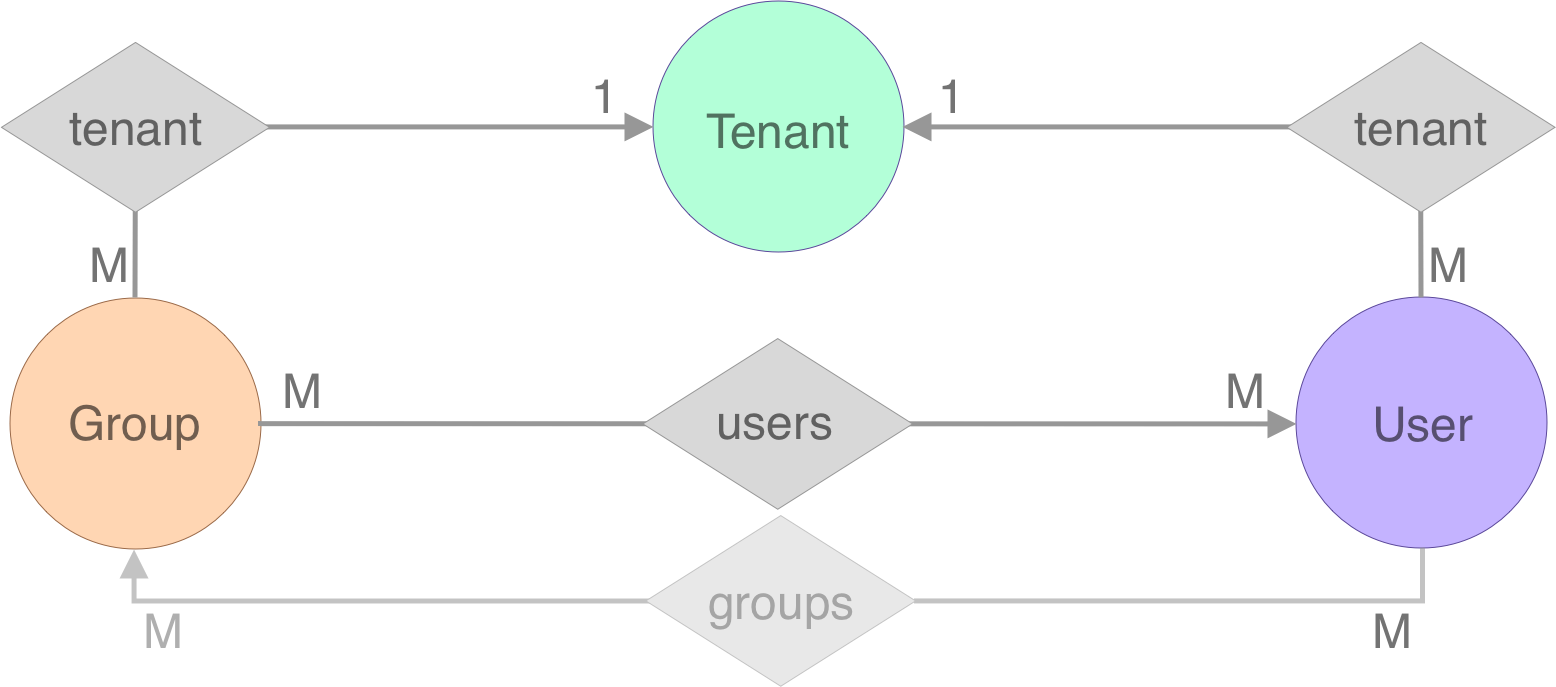
In this example, we're going to create a schema with 3 entity types - `Tenant`, `User` and `Group`.
|
||
The helper packages `viewer` and `rule` (as mentioned above) also exist in this example to help us structure the application.
|
||
|
||
|
||
|
||
Let's start building this application piece by piece. We begin by creating 3 different schemas (see the full code [here](https://github.com/ent/ent/tree/master/examples/privacytenant/ent/schema)),
|
||
and since we want to share some logic between them, we create another [mixed-in schema](schema-mixin.md) and add it to all other schemas as follows:
|
||
|
||
```go title="examples/privacytenant/ent/schema/mixin.go"
|
||
// BaseMixin for all schemas in the graph.
|
||
type BaseMixin struct {
|
||
mixin.Schema
|
||
}
|
||
|
||
// Policy defines the privacy policy of the BaseMixin.
|
||
func (BaseMixin) Policy() ent.Policy {
|
||
return privacy.Policy{
|
||
Mutation: privacy.MutationPolicy{
|
||
rule.DenyIfNoViewer(),
|
||
},
|
||
Query: privacy.QueryPolicy{
|
||
rule.DenyIfNoViewer(),
|
||
},
|
||
}
|
||
}
|
||
```
|
||
|
||
```go title="examples/privacytenant/ent/schema/tenant.go"
|
||
// Mixin of the Tenant schema.
|
||
func (Tenant) Mixin() []ent.Mixin {
|
||
return []ent.Mixin{
|
||
BaseMixin{},
|
||
}
|
||
}
|
||
```
|
||
|
||
As explained in the first example, the `DenyIfNoViewer` privacy rule, denies the operation if the `context.Context` does not
|
||
contain the `viewer.Viewer` information.
|
||
|
||
Similar to the previous example, we want add a constraint that only admin users can create tenants (and deny otherwise).
|
||
We do it by copying the `AllowIfAdmin` rule from above, and adding it to the `Policy` of the `Tenant` schema:
|
||
|
||
```go title="examples/privacytenant/ent/schema/tenant.go"
|
||
// Policy defines the privacy policy of the User.
|
||
func (Tenant) Policy() ent.Policy {
|
||
return privacy.Policy{
|
||
Mutation: privacy.MutationPolicy{
|
||
// For Tenant type, we only allow admin users to mutate
|
||
// the tenant information and deny otherwise.
|
||
rule.AllowIfAdmin(),
|
||
privacy.AlwaysDenyRule(),
|
||
},
|
||
}
|
||
}
|
||
```
|
||
|
||
Then, we expect the following code to run successfully:
|
||
|
||
```go title="examples/privacytenant/example_test.go"
|
||
func Do(ctx context.Context, client *ent.Client) error {
|
||
// Expect operation to fail, because viewer-context
|
||
// is missing (first mutation rule check).
|
||
if _, err := client.Tenant.Create().Save(ctx); !errors.Is(err, privacy.Deny) {
|
||
return fmt.Errorf("expect operation to fail, but got %w", err)
|
||
}
|
||
// Deny tenant creation if the viewer is not admin.
|
||
viewCtx := viewer.NewContext(ctx, viewer.UserViewer{Role: viewer.View})
|
||
if _, err := client.Tenant.Create().Save(viewCtx); !errors.Is(err, privacy.Deny) {
|
||
return fmt.Errorf("expect operation to fail, but got %w", err)
|
||
}
|
||
// Apply the same operation with "Admin" role, expect it to pass.
|
||
adminCtx := viewer.NewContext(ctx, viewer.UserViewer{Role: viewer.Admin})
|
||
hub, err := client.Tenant.Create().SetName("GitHub").Save(adminCtx)
|
||
if err != nil {
|
||
return fmt.Errorf("expect operation to pass, but got %w", err)
|
||
}
|
||
fmt.Println(hub)
|
||
lab, err := client.Tenant.Create().SetName("GitLab").Save(adminCtx)
|
||
if err != nil {
|
||
return fmt.Errorf("expect operation to pass, but got %w", err)
|
||
}
|
||
fmt.Println(lab)
|
||
return nil
|
||
}
|
||
```
|
||
|
||
We continue by adding the rest of the edges in our data-model (see image above), and since both `User` and `Group` have
|
||
an edge to the `Tenant` schema, we create a shared [mixed-in schema](schema-mixin.md) named `TenantMixin` for this:
|
||
|
||
```go title="examples/privacytenant/ent/schema/mixin.go"
|
||
// TenantMixin for embedding the tenant info in different schemas.
|
||
type TenantMixin struct {
|
||
mixin.Schema
|
||
}
|
||
|
||
// Edges for all schemas that embed TenantMixin.
|
||
func (TenantMixin) Edges() []ent.Edge {
|
||
return []ent.Edge{
|
||
edge.To("tenant", Tenant.Type).
|
||
Unique().
|
||
Required(),
|
||
}
|
||
}
|
||
```
|
||
|
||
Next, we may want to enforce a rule that will limit viewers to only query groups and users that are connected to the tenant they belong to.
|
||
For use cases like this, Ent has an additional type of privacy rule named `Filter`.
|
||
We can use `Filter` rules to filter out entities based on the identity of the viewer.
|
||
Unlike the rules we previously discussed, `Filter` rules can limit the scope of the queries a viewer can make, in addition to returning privacy decisions.
|
||
|
||
> Note, the privacy filtering option needs to be enabled using the [`entql`](features.md#entql-filtering) feature-flag (see instructions [above](#configuration)).
|
||
|
||
```go title="examples/privacytenant/rule/rule.go"
|
||
// FilterTenantRule is a query/mutation rule that filters out entities that are not in the tenant.
|
||
func FilterTenantRule() privacy.QueryMutationRule {
|
||
// TenantsFilter is an interface to wrap WhereHasTenantWith()
|
||
// predicate that is used by both `Group` and `User` schemas.
|
||
type TenantsFilter interface {
|
||
WhereHasTenantWith(...predicate.Tenant)
|
||
}
|
||
return privacy.FilterFunc(func(ctx context.Context, f privacy.Filter) error {
|
||
view := viewer.FromContext(ctx)
|
||
if view.Tenant() == "" {
|
||
return privacy.Denyf("missing tenant information in viewer")
|
||
}
|
||
tf, ok := f.(TenantsFilter)
|
||
if !ok {
|
||
return privacy.Denyf("unexpected filter type %T", f)
|
||
}
|
||
// Make sure that a tenant reads only entities that has an edge to it.
|
||
tf.WhereHasTenantWith(tenant.Name(view.Tenant()))
|
||
// Skip to the next privacy rule (equivalent to return nil).
|
||
return privacy.Skip
|
||
})
|
||
}
|
||
```
|
||
|
||
After creating the `FilterTenantRule` privacy rule, we add it to the `TenantMixin` to make sure **all schemas**
|
||
that use this mixin, will also have this privacy rule.
|
||
|
||
```go title="examples/privacytenant/ent/schema/mixin.go"
|
||
// Policy for all schemas that embed TenantMixin.
|
||
func (TenantMixin) Policy() ent.Policy {
|
||
return privacy.Policy{
|
||
Query: privacy.QueryPolicy{
|
||
rule.AllowIfAdmin(),
|
||
// Filter out entities that are not connected to the tenant.
|
||
// If the viewer is admin, this policy rule is skipped above.
|
||
rule.FilterTenantRule(),
|
||
},
|
||
}
|
||
}
|
||
```
|
||
|
||
Then, after running the code-generation, we expect the privacy-rules to take effect on the client operations.
|
||
|
||
```go title="examples/privacytenant/example_test.go"
|
||
func Do(ctx context.Context, client *ent.Client) error {
|
||
// A continuation of the code-block above.
|
||
|
||
// Create 2 users connected to the 2 tenants we created above
|
||
hubUser := client.User.Create().SetName("a8m").SetTenant(hub).SaveX(adminCtx)
|
||
labUser := client.User.Create().SetName("nati").SetTenant(lab).SaveX(adminCtx)
|
||
|
||
hubView := viewer.NewContext(ctx, viewer.UserViewer{T: hub})
|
||
out := client.User.Query().OnlyX(hubView)
|
||
// Expect that "GitHub" tenant to read only its users (i.e. a8m).
|
||
if out.ID != hubUser.ID {
|
||
return fmt.Errorf("expect result for user query, got %v", out)
|
||
}
|
||
fmt.Println(out)
|
||
|
||
labView := viewer.NewContext(ctx, viewer.UserViewer{T: lab})
|
||
out = client.User.Query().OnlyX(labView)
|
||
// Expect that "GitLab" tenant to read only its users (i.e. nati).
|
||
if out.ID != labUser.ID {
|
||
return fmt.Errorf("expect result for user query, got %v", out)
|
||
}
|
||
fmt.Println(out)
|
||
return nil
|
||
}
|
||
```
|
||
|
||
We finish our example with another privacy-rule named `DenyMismatchedTenants` on the `Group` schema.
|
||
The `DenyMismatchedTenants` rule rejects group creation if the associated users don't belong to
|
||
the same tenant as the group.
|
||
|
||
```go title="examples/privacytenant/rule/rule.go"
|
||
// DenyMismatchedTenants is a rule that runs only on create operations and returns a deny
|
||
// decision if the operation tries to add users to groups that are not in the same tenant.
|
||
func DenyMismatchedTenants() privacy.MutationRule {
|
||
return privacy.GroupMutationRuleFunc(func(ctx context.Context, m *ent.GroupMutation) error {
|
||
tid, exists := m.TenantID()
|
||
if !exists {
|
||
return privacy.Denyf("missing tenant information in mutation")
|
||
}
|
||
users := m.UsersIDs()
|
||
// If there are no users in the mutation, skip this rule-check.
|
||
if len(users) == 0 {
|
||
return privacy.Skip
|
||
}
|
||
// Query the tenant-id of all users. Expect to have exact 1 result,
|
||
// and it matches the tenant-id of the group above.
|
||
id, err := m.Client().User.Query().Where(user.IDIn(users...)).QueryTenant().OnlyID(ctx)
|
||
if err != nil {
|
||
return privacy.Denyf("querying the tenant-id %v", err)
|
||
}
|
||
if id != tid {
|
||
return privacy.Denyf("mismatch tenant-ids for group/users %d != %d", tid, id)
|
||
}
|
||
// Skip to the next privacy rule (equivalent to return nil).
|
||
return privacy.Skip
|
||
})
|
||
}
|
||
```
|
||
|
||
We add this rule to the `Group` schema and run code-generation.
|
||
|
||
```go title="examples/privacytenant/ent/schema/group.go"
|
||
// Policy defines the privacy policy of the Group.
|
||
func (Group) Policy() ent.Policy {
|
||
return privacy.Policy{
|
||
Mutation: privacy.MutationPolicy{
|
||
// Limit DenyMismatchedTenants only for
|
||
// Create operation
|
||
privacy.OnMutationOperation(
|
||
rule.DenyMismatchedTenants(),
|
||
ent.OpCreate,
|
||
),
|
||
},
|
||
}
|
||
}
|
||
```
|
||
|
||
Again, we expect the privacy-rules to take effect on the client operations.
|
||
|
||
```go title="examples/privacytenant/example_test.go"
|
||
func Do(ctx context.Context, client *ent.Client) error {
|
||
// A continuation of the code-block above.
|
||
|
||
// Expect operation to fail because the DenyMismatchedTenants rule
|
||
// makes sure the group and the users are connected to the same tenant.
|
||
_, err = client.Group.Create().SetName("entgo.io").SetTenant(hub).AddUsers(labUser).Save(adminCtx)
|
||
if !errors.Is(err, privacy.Deny) {
|
||
return fmt.Errorf("expect operation to fail, since user (nati) is not connected to the same tenant")
|
||
}
|
||
_, err = client.Group.Create().SetName("entgo.io").SetTenant(hub).AddUsers(labUser, hubUser).Save(adminCtx)
|
||
if !errors.Is(err, privacy.Deny) {
|
||
return fmt.Errorf("expect operation to fail, since some users (nati) are not connected to the same tenant")
|
||
}
|
||
entgo, err := client.Group.Create().SetName("entgo.io").SetTenant(hub).AddUsers(hubUser).Save(adminCtx)
|
||
if err != nil {
|
||
return fmt.Errorf("expect operation to pass, but got %w", err)
|
||
}
|
||
fmt.Println(entgo)
|
||
return nil
|
||
}
|
||
```
|
||
|
||
In some cases, we want to reject user operations on entities that don't belong to their tenant **without loading
|
||
these entities from the database** (unlike the `DenyMismatchedTenants` example above).
|
||
To achieve this, we can use the `FilterTenantRule` rule for mutations as well, but limit it to specific operations as follows:
|
||
|
||
```go title="examples/privacytenant/ent/schema/group.go"
|
||
// Policy defines the privacy policy of the Group.
|
||
func (Group) Policy() ent.Policy {
|
||
return privacy.Policy{
|
||
Mutation: privacy.MutationPolicy{
|
||
// Limit DenyMismatchedTenants only for
|
||
// Create operations
|
||
privacy.OnMutationOperation(
|
||
rule.DenyMismatchedTenants(),
|
||
ent.OpCreate,
|
||
),
|
||
// Limit the FilterTenantRule only for
|
||
// UpdateOne and DeleteOne operations.
|
||
privacy.OnMutationOperation(
|
||
rule.FilterTenantRule(),
|
||
ent.OpUpdateOne|ent.OpDeleteOne,
|
||
),
|
||
},
|
||
}
|
||
}
|
||
```
|
||
|
||
Then, we expect the privacy-rules to take effect on the client operations.
|
||
|
||
```go title="examples/privacytenant/example_test.go"
|
||
func Do(ctx context.Context, client *ent.Client) error {
|
||
// A continuation of the code-block above.
|
||
|
||
// Expect operation to fail, because the FilterTenantRule rule makes sure
|
||
// that tenants can update and delete only their groups.
|
||
err = entgo.Update().SetName("fail.go").Exec(labView)
|
||
if !ent.IsNotFound(err) {
|
||
return fmt.Errorf("expect operation to fail, since the group (entgo) is managed by a different tenant (hub), but got %w", err)
|
||
}
|
||
entgo, err = entgo.Update().SetName("entgo").Save(hubView)
|
||
if err != nil {
|
||
return fmt.Errorf("expect operation to pass, but got %w", err)
|
||
}
|
||
fmt.Println(entgo)
|
||
return nil
|
||
}
|
||
```
|
||
|
||
The full example exists in [GitHub](https://github.com/ent/ent/tree/master/examples/privacytenant).
|
||
|
||
Please note that this documentation is under active development.
|